









Open Space Technology
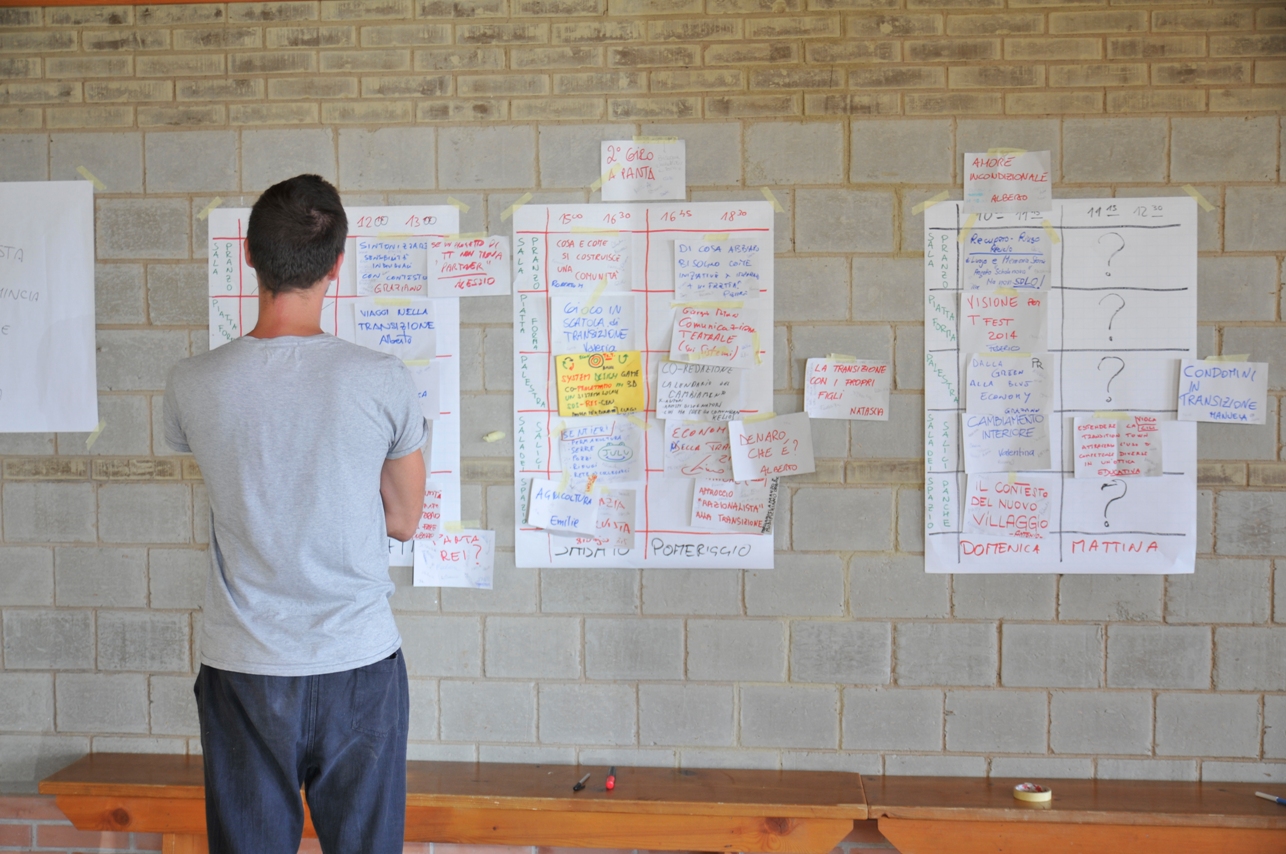
Open Space is a methodology for large groups to create their agenda discerning important topics for discussion, suitable for conferences, community gatherings and whole system facilitation
Open Space is a methodology for large groups to create their agenda discerning important topics for discussion, suitable for conferences, community gatherings and whole system facilitation
A process for understanding a complex problem situation

You can help individuals or groups avoid the frequent mistake of trying to solve a problem with methods that are not adapted to the nature of their challenge. The combination of two questions makes it possible to easily sort challenges into four categories: simple, complicated, complex, and chaotic.
A loose analogy may be used to describe these differences: simple is like following a recipe, complicated like sending a rocket to the moon, complex like raising a child, and chaotic is like the game “Pin the Tail on the Donkey.”
The Liberating Structures Matching Matrix in Chapter 5 can be used as the first step to clarify the nature of a challenge and avoid the mismatches between problems and solutions that are frequently at the root of chronic, recurring problems.

We don’t truly have a good grasp of a situation until we see it in a fuller context. The Context Map is designed to show us the external factors, trends, and forces at work surrounding an organization. Because once we have a systemic view of the external environment we’re in, we are better equipped to respond proactively to that landscape.
You can use the Draw Toast exercise to introduce people to the concepts of visual thinking, working memory, mental models and/or systems thinking.
This also works as a nice warm-up exercise to get people engaged with each other and thinking visually. Plus, it’s fun!
A subset of people with direct field experience can quickly foster understanding, spark creativity, and facilitate adoption of new practices among members of a larger community. Fishbowl sessions have a small inside circle of people surrounded by a larger outside circle of participants. The inside group is formed with people who made concrete progress on a challenge of interest to those in the outside circle. The fishbowl design makes it easy for people in the inside circle to illuminate what they have done by sharing experiences while in conversation with each other. The informality breaks down the barriers with direct communication between the two groups of people and facilitates questions and answers flowing back and forth. This creates the best conditions for people to learn from each other by discovering answers to their concerns themselves within the context of their working groups. You can stop imposing someone else’s practices!
The SWOT Analysis is a long-standing technique of looking at what we have, with respect to the desired end state, as well as what we could improve on. It gives us an opportunity to gauge approaching opportunities and dangers, and assess the seriousness of the conditions that affect our future. When we understand those conditions, we can influence what comes next.
A questioning method for generating, explaining, investigating ideas.

By using the metaphor of a sailboat, teams can articulate what is working well and also, what is holding the organization back. Individually think about and note down:
What is moving us forward and What is Holding us back in as an organization or team.
Moving us forward: what's working for us, what's really good.
Holding us back: what challenges are we facing?

Use a remote-friendly version of the classic note and vote exercise to generate ideas quickly, vote on the most suitable, and turn them into how might we statements your group can move forward with!
In Options Place, participants propose and lead their own breakout sessions instead of following a preset agenda. This unleashes people’s creativity and invites them to attend sessions that match their interests. When given the freedom to shape the agenda, participants become more engaged and take greater ownership of solutions, which leads to greater commitment, action, innovation, and follow-through. In this way, Options Place brings to life LS Principle #6, Amplify Freedom and Responsibility. This structure works well for large groups.

A fast and loud method to enhance brainstorming within a team. Since this activity has more than round ideas that are repetitive can be ruled out leaving more creative and innovative answers to the challenge.