Large group workshop agenda - from World Bank Development Forum

Objectives
This workshop agenda shows a practical example of how to manage a group process with 300 participants and keep it interactive through its design. By bringing together many elements of a large scale session design, it serves as inspiration to help anyone looking to work with large groups.
What are the key takeaways from this session plan?
- Using a data driven approach to form sub-groups for breakout sessions
- Creating a balanced group process by incorporating a variety of building blocks in the right sequence:
- Presentations from keynote speakers
- Facilitating a whole room discussion
- On-stage interviews
- Running panel discussions
- Small group exercises working on case studies
- Participants sharing learnings from breakout groups
- Large-scale networking
Instructions
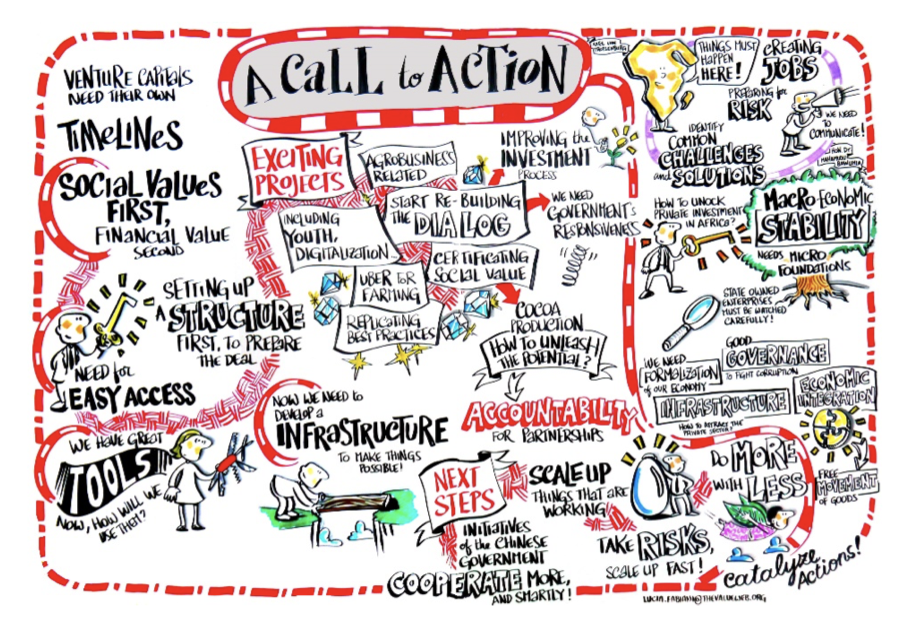
The World Bank Group began re-thinking the way they invest development capital in West Africa in 2017. With multiple parties from all over the world affected, convening the experts into one room was necessary to shift from billions to trillions in investment.
In order to connect the right individuals and businesses in an effort to reduce poverty, the World Bank Group took an approach driven by data and design that integrates network science, multiple design methods and data analysis to achieve greater impact.
The organizers followed a 3-step process to prepare (detailed and illustrated in this blogpost from Collaboration.ai)
- Get serious about data on the participants:
- With some groups, it is possible to only use social data. But given an analysis of the population that was going to be in attendance at the workshop in Accra, social data alone was not sufficient
- Use event registration to your advantage:
- WBG treated registration as a ‘search’ mechanism to understand their participants and ensure ‘impact paths.’ During the registration process, information was collected about areas of expertise, specific skills, topics of interest, existing and desired relationships.
- The results identified seven distinct communities of participants with minimal overlap between them. Not surprisingly, these were defined as the existing silos between development community, finance experts, entrepreneurs, industries, etc.
- Use the data to change the design approach:
- Each participants’ data was looked at, including the connections between them with respect to the short and long term objectives of the event: This way each participant was mapped individually based on their existing connections, so that they get connected across the paths of content to help people to achieve the long term goals. (This frequently means that a banker is in a group with another banker (but with a new connection!) and ALSO with an artist and local farmer for instance to solve risk mitigation in agricultural projects!
- By understanding each participant’s data points and intelligently linking them to one another, genuine connectivity ensued leading to the identification of 50 impactful projects.
Video from the event available here