Employee training materials: a practical guide for instructor-led training

Ask most people what they mean by "employee training materials" and they'll gesture vaguely toward slides. Maybe a handout. If you're lucky, a printed agenda that's been living in the same folder since 2019 and has survived three team restructures and a global pandemic.
That definition isn't wrong, exactly. But if you're an L&D professional running instructor-led training at any kind of scale, it's incomplete in ways that quietly cause real problems: inconsistent delivery, facilitators left to improvise, participants who don’t have materials to refer back to, and a slow accumulation of variations of the same document living in three different shared drives.
This post is for the people trying to build something more coherent than that. We’ll cover what a complete set of training materials actually includes, what each component is for, and how to organise and maintain them so they don’t become a liability the moment the person who built them goes on leave.
(A quick note: if you landed here looking for compliance-specific training materials—OSHA documentation, mandatory certification packs—some of what follows will apply, but this post is primarily aimed at facilitators and L&D teams designing and running instructor-led training programs.)
What training materials are (and what they’re for)
Training materials are everything that supports a training program to happen consistently and well: before, during, and after the session itself.
That last part matters. Materials aren’t just the stuff in the room; they’re also what participants receive to prepare, what facilitators use to deliver, and what the organization retains as institutional knowledge once the program runs.
That’s three separate jobs, and it helps to be clear about them:
Supporting the facilitator to deliver consistently, regardless of how experienced they are with this specific content. A strong facilitator can lead almost anything with the right preparation. Without it, you’re relying on memory and improvisation: which is fine the first time you run something yourself, and less fine when someone else is delivering your session in a different continent.
Supporting participants to engage before, during, and after the session. Training is not a single event; it’s a process. Good materials help participants arrive ready, stay oriented during the session, and do something with what they’ve learned afterward.
Supporting the organization to maintain, update, and scale the program over time. This is the job that gets ignored most often, and it’s the one that creates the most pain later. Precisely because it so often gets ignored, this is an aspect we’ll keep coming back to in this article, detailing solutions and tips to ensure your training materials are well-organized from an organizational point of view.
The essential set: a complete checklist
Here’s what a complete set of ILT training materials typically includes.
Not every program needs all of these (a short one-hour onboarding session has different needs than a three-day leadership development course), but this is the full picture. Let’s look at each in turn.
(1) Facilitator guide
The facilitator guide is the backbone of consistent delivery. It’s not a script. A good facilitator guide leaves room for the facilitator’s style and judgment, but it contains everything they need to deliver the session without having to reconstruct it from scratch.
That means: learning objectives, a timed run of show, facilitation notes for each activity (what to do, and how to handle common responses or difficulties), key talking points, and any logistics the facilitator needs to manage.
For a detailed walkthrough of what goes into each component, check out this post on how to create more effective facilitator guides. There’s also a ready-to-use facilitator guide template if you want a concrete starting point.

(2) Session agenda or run of show
Distinct from the facilitator guide, though they often live together: a clean, timed agenda that can be shared with co-facilitators, observers, or anyone who needs to understand the shape of the session without reading the full guide.
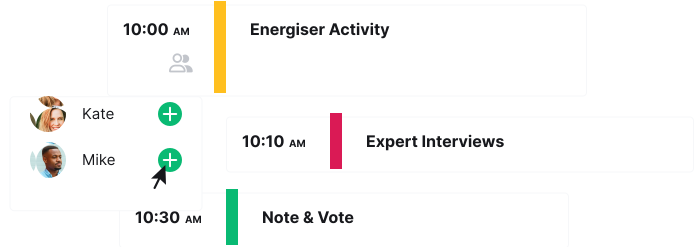
While a facilitator’s guide includes detailed information on what happens before and after the session, the agenda is more like a script for the day. In SessionLab’s planner, the agenda is neatly divided in columns showing, at a glance, the timeline, type of activity, and extra columns to add instructions, materials, assign tasks and more.
In some cases you might want to share a simplified version of this with participants in advance. Participants typically do not need to have a minute-by-minute rundown of what will happen, which would just be confusing and overwhelming (not to mention set expectations that might get shattered if trainers decide to pivot). What they do need is clarity about starting and end times, main breaks, and a sense of what type of activities to expect.
When designing an agenda, I keep in mind that I’ll probably want to share the title of each section with participants, and often formulate it as a question that will get answered in that section (as in: “What will we do today?” or “What have we learnt?”) which I think can help raise motivation and understanding.

(3) Slides
Slides support the facilitator and orient participants. They’re not the session. The best training slides are sparse enough that they don’t do all the talking, and structured enough that they match the agenda beat-for-beat so no one is hunting for the right slide in the middle of a transition.
One thing I’ve learned to do consistently over the years is write out the instructions for interactive activities directly on the slide. It started as a conscious attempt to be more inclusive. Participants with neurodiversity often benefit from having written instructions they can refer back to, rather than trying to hold a verbal explanation in working memory while also getting ready to do the task.
The more I did it, the more I realised it helps everyone. A slide that reads, for example: “In pairs, spend five minutes discussing. The topic is: Share a story about how feedback that changed how you work” removes ambiguity, gives people a moment to read and settle before they begin, and means the facilitator doesn’t have to repeat themselves three times.
Giving clear, well-structured instructions is one of the core competencies of a good facilitator, and putting them on a slide (whether you’re in the room or online) makes that clarity visible and accessible to all.
Slides are the material most likely to drift out of sync with everything else. Treat them as a living document and make sure they’re versioned alongside the rest of your materials (if this is a concern, find more tips on versioning below).
(4) Participant workbook or handouts
Probably the most useful thing I’ve done to structure my training courses over the years was creating a full digital workbook for an introduction to facilitation training I deliver to a new group of students every year.
I spent a good few days writing out frameworks, activities, reflection prompts, and reference material spanning the entire program. I added original illustrations and fidgeted endlessly over layout and typos. Back then, it honestly felt like I was investing a bit too much time in it.
But now, five years later, I have five years’ experience with being able to quickly send it to participants before we begin, so they can use it to prepare, follow along during sessions, and come back to it afterward. I give it a quick look-over for revisions and update it every year, but it’s been worth the investment many times over. It’s also something I’ve sent potential new clients to give them a clear idea of the kind of content I could deliver for them (and it worked).
What I find most satisfying about it is the long tail. I train young people in facilitation, and years later, some of them will get in touch to say they reached back for a particular framework or activity in the workbook and finally had a real-world need for it. A well-designed workbook can become a resource that keeps working long after the session is over.
For online training, the equivalent of a participant workbook might be a shared digital workspace: a Miro board, a collaborative document, or a structured folder participants can access throughout the program. Our friends over at the training company Voltage Control, for example, give participants in their facilitation certification program access to a board that maps their entire learning journey, so they can orient themselves, see what’s ahead, and come to each session prepared.

(5) Pre-work
Pre-work is underused and underestimated. At its best, it does two things: it starts priming participants for the kind of thinking or learning the session will require, and it makes the case for why they should care.
That second job matters more than it’s often given credit for. Adult learners, especially in corporate settings, come to training with competing priorities and varying degrees of motivation. Pre-work that’s well-designed and genuinely engaging can shift someone from “I have to attend this” to “I’m curious about this” before the session even begins. Keep it short, make it specific, and connect it clearly to what the session will cover.
And yes, maybe most of the people will not actually complete the pre-work and, in general, that is ok. I usually thank the people who did, and mention they will be better prepared, but this is not generally something to enforce. A quick scroll through questions and activities, even if people don’t find the time or the motivation to fill them out, is better than nothing.
What might constitute pre-work? The format should fit both the content and the people receiving it. Some options to consider:
- A few reflection questions in an email survey. The simplest and often most effective option. Ask participants to think about something relevant before they arrive: an experience, a challenge, an opinion.
Low friction, easy to prepare, and already doing the priming work before anyone has opened a slide deck. For more on why pre-work surveys are important, and what functions they might have, check out this dedicated article. - A short video to watch. Useful when you want to introduce a concept or framework without using session time for it. Works well for more theory-heavy programs where you want participants to arrive with a shared reference point.
- A worksheet to fill in and bring. Adds a layer of active engagement: participants don’t just receive information, they do something with it. Good for programs where personal reflection or self-assessment is part of the learning arc.
- A reading or case study. Best kept short and purposeful. A two-page case study that participants have read and thought about will generate far richer discussion than one handed out in the room.
- Access to a shared digital workspace. For longer programs, giving participants early access to a Miro board, shared document, or learning platform lets them orient themselves, see the shape of what’s ahead, and arrive with a sense of context.
To give an example, in my facilitation training courses, pre-work might involve reading a short case study about a facilitated meeting, then answering a few personal reflection questions. “When have I experienced collaboration working well, and what was that like?”. This might become the prompt of one of our first activities when we meet. It also sets up a certain mood for the training, in this case making it clear that it will be participatory and reflective.

(6) Follow-up materials
What happens after the session is over is where most training programs leak value. Participants leave with good intentions and re-enter their regular context, which has a powerful pull toward the status quo.
Follow-up materials won’t fix that entirely, but they help. A 30-day check-in with activities to run a personal assessment of what learning “stuck”. A summary of key frameworks from the session. A job aid for applying a specific skill. The goal is to extend the learning arc past the session itself and give participants something to return to.
In a recent session that trainer-of-trainers Mirna Smidt gave in our community, about becoming better storytellers, her follow-up material kit included lists of recommended books and podcasts. Participants who leave a training with enthusiasm might find themselves particularly receptive; it could be just the right moment to send them to continue their learning journey with something new.
(7) Feedback forms
Feedback forms serve two audiences: the organization (is this training working?) and the facilitator (how can I improve?).
Immediate post-session feedback captures reaction while it’s fresh. A follow-up survey at 30 days (sometimes 60 or 90) captures what’s actually stuck and whether participants have been able to apply what they learned. The gap between those two data points is often where the most useful information lives. If you’re building out your survey questions, this guide on pre and post-training surveys covers both what to ask and how to use the responses well.

(8) Physical materials
The materials you bring into the room say something to participants before you’ve opened your mouth. A cluttered table, dried-out markers, and sticky notes that don’t stick communicate one thing. A thoughtfully prepared space communicates another.
I travel with a light bag of essentials: a few favorite card decks, a soft ball for taking speaking turns, a bell to signal time, Neuland markers (rechargeable, essential), and a small stash of sticky notes just in case. What’s in that bag has been refined over years of finding out what I actually reach for. Everything else I either source locally or ask the client to provide.
Which raises a practical point: in most training programs, materials come from more than one place, and tracking who is bringing what is its own small coordination problem.
The best time to think about materials is not the morning of the session. A dedicated checklist for each training program, built and refined ahead of time, is one of those small investments that pays back disproportionately, especially when materials are coming from more than one source.
SessionLab’s materials column in the Session Planner is useful here: you can note directly against each activity what’s needed and who’s responsible for it, so nothing arrives in the room as a surprise. This also keeps your checklist attached to the session it belongs to, rather than living in a separate document that gets separated from the agenda right when you need both.
For an in-depth look at how to build your pre-session preparation process, SessionLab’s complete guide to workshop planning covers checklists, logistics, and the full arc from first client conversation to post-session follow-up. It’s a free download and worth keeping close.
A few principles worth holding:
- There should always be enough for everyone. This sounds obvious; it is surprisingly often not the case. Count participants, add a buffer, prepare ahead.
- Think carefully before you print or pack. Last year I facilitated a large-scale EU event and made a classic mistake: I over-specified the materials list, and the organising team ended up carrying bags of markers and reams of paper on a plane to get them there. We used a fraction of it. The environmental cost of what went unused sat with me afterward. Now I plan materials conservatively, confirm what the venue already has, and treat print runs and physical supplies as decisions that deserve the same care as the session design itself.
- A small takeaway makes the session stick. Something physical participants are encouraged to bring home creates a memory anchor the slide deck never will. As many Lego Serious Play aficionados know, something as simple as a LEGO duck—which looks like a gimmick and turns out to be genuinely memorable—can do that job well.

Common failure modes
Even the most carefully designed training program suffers if the materials supporting it aren’t working. Some of these failure modes are dramatic enough to notice in the room; others are quieter, accumulating over multiple runs until someone finally asks why employees complete what is supposed to be the “same” training course with wildly diverging experiences. Here are some common pitfalls worth watching for.
- The slide-only “guide.” A deck of slides sent to a facilitator with the note “you can use these as your guide” is not a facilitator guide. Slides don’t contain timing, facilitation notes, handling tips, or learning rationale. What you get from a slide-only approach is delivery that varies greatly among facilitators. If that sounds familiar, you might want to share our tips on how to create better facilitator guides with your team.
- No follow-up materials. Participants leave a session, return to their desks, and have no artefact from the experience that connects to their day-to-day work. Three weeks later, the training happened and that’s about all that remains. Follow-up materials aren’t a nice-to-have; they’re part of making the training investment worth anything.
- Materials that exist for compliance, not for use. Some organizations produce training materials because they’re supposed to have training materials, not because anyone expects them to be used. These tend to be long, defensive, and dense, designed to prove that training happened rather than to make training work. If your facilitator guide is mostly legal disclaimers, it’s not really a facilitator guide.
And, let’s be honest, this is not really a materials issue, it’s more likely a trust issue. If this sounds like your workplace, it might be the time to delve a bit deeper into group dynamics with your team: here is a template that might inspire you. - Version chaos. “Final,” “Final_v2,” “Final_USE THIS ONE,” “Final_actually final.” If that’s what attachments look like in your world, you don’t have a versioning system: you have an honour system, and honour systems fail. Which leads us to the section on how to organize training materials, coming up next.
How to organize your training materials
Having all the materials listed above is one problem. Maintaining them in a state that someone else can find, understand, and use without calling you is a different (and knottier) problem.
Here are some tried-and-tested tips that help:
- Establish a single source of truth. This sounds obvious. It is, in fact, not how most training libraries work in practice. Materials accumulate across shared drives, email attachments, individual laptops, and presentation tools, and the version in the room on the day is often not the one anyone would point to if asked. Pick one place. Everything lives there.
- Use a consistent naming convention. Something like
[Program name]_[Material type]_[Version]_[Date]is unglamorous but functional. The goal is that anyone on your team can find any version of any document without having to ask. - Think about data architecture. Especially in larger organizations, materials collections can quickly snowball into an unmanageable avalanche. In a small agency, a single, well-organized workspace is enough. But when we start talking about multiple programs spanning multiple teams and regional offices, it becomes absolutely necessary to carefully consider data architecture by creating dedicated workspaces and uniformly tagging materials.
- Attach training materials to the appropriate training program. As a corollary to these first three points, make sure it’s easy to connect the right program to the right materials. This should function both ways: a trainer handed a worksheet should be able to immediately trace it back to the right session (this can be as simple as a reference in the document header or footer). Conversely, anyone opening a session for the first time should easily find all the related materials through links and checklists.
As we’ll see below, SessionLab makes all of this a breeze with workspaces, internal libraries, and a well-organized knowledge base for training and facilitation programs. - Manage access deliberately. Who can view, and who can edit? Facilitation guides and master slide decks probably need tighter controls than participant handouts. Think about what happens when a new facilitator joins the team, or when someone leaves.
- Build a localization workflow if you work across regions or languages. If your program runs in multiple markets, translation and cultural adaptation isn’t a one-time task; it’s a recurring part of your materials workflow. Build that into your process rather than treating it as an exception.

How to maintain and update training materials
Training materials are not finished when they’re first created. They need to be reviewed, updated, and maintained, and that doesn’t happen by accident.
If in 2026 trainers keep using slides in their introduction that say things like “Please respect social distancing”, because those slides come from late 2021, it’s high time for an update. Each time the trainer gets to that slide, they’ll smirk, skip it, and mumble something about “yeah, we have to change that one”. Except it never gets updated. Why?
Most often, updates aren’t made because it’s not clear who should review materials, when, and how to let the right people know what needs changing.
Set a review cadence and stick to it. For most programs, an annual review is a reasonable minimum; for anything tied to rapidly-changing content (compliance, product knowledge, regulatory requirements), more frequent reviews are necessary.
Assign ownership. Someone needs to be responsible for each program’s materials. Without a named owner, reviews get deferred, updates get missed, and the materials slowly diverge from reality.
Create a feedback channel. Facilitators who run the session regularly will notice things that aren’t visible from the outside: talking points that land differently in practice, activities that run over time, and sections where participants consistently get lost. Build in a way to collect and act on that feedback.
For this to be possible in practice, there need to be two enabling conditions: a clear process in place, and a quick way to access all materials related to the training in one place, and update them in one go. Next time the session is repeated, trainers will find in a centralized repository only the updated version, rather than go digging into email chains.
From the participants’ point of view, this means always having updated materials that are actually relevant to the moment, rather than feeling they are being fed stale content from a decade ago. Also, it’s worth noting that updating existing materials is way more efficient than creating new things from scratch.

How SessionLab helps organize training materials
For facilitators and L&D teams building and managing training materials, the challenge isn’t usually a lack of content. It’s the infrastructure around it. Where does everything live? Who has access? How do you know which version is current?
SessionLab is built around the idea that your session design and your supporting materials should live in the same place, not in five different tools.
The Session Planner gives facilitators a live, timed view of the session: agenda, activities, timing, all in one place to work from directly, rather than needing a separate run-of-show document.
Pages let you build facilitator guides, participant handouts, and program documentation directly inside SessionLab, attached to the session they belong to. No hunting across drives for the document that goes with this session; it’s there.
The Team Library is where your organization’s reusable materials (activities, agendas, guides) live centrally and stay findable. When a facilitator joins your team, they’re not starting from scratch; they’re starting from your library.
Forms handle pre-work and feedback collection without leaving the platform. A pre-session survey, a post-session evaluation, a 30-day follow-up: you can build these in SessionLab and attach them to the session they belong to, which means your feedback data lives alongside the program it’s about.

Put together, these features mean the busywork of managing training materials largely takes care of itself. A facilitator preparing to deliver a course for the first time finds the guide, the agenda, the pre-work form, and the feedback survey all attached to the same session. Now they can put all their energy and focus into the actual participants and delivery in the moment.
An L&D manager reviewing what’s being delivered across a team of ten trainers has one place to look, not ten inboxes to search, which sounds like a lot less frustration for everyone involved. The goal is to make the right materials findable, usable, and improvable every time the program runs.
We can rapidly reuse elements from previous sessions to create new agendas. It’s potentially a 60% time saving for the preparation of similar session formats.
Tracey Benettolo – Senior Manager, Deloitte Greenhouse
In closing
Whether you’re starting from scratch or trying to bring order to a materials library that’s grown a little wild, we hope this gives you a clear enough picture of what good looks like to take the next step.
Here are three resources from our blog and publication that we recommend looking into for more on this topic:
- Facilitator guides are a core part of training materials. Nailing how these are created, populated and organized is key to running well-organized training programs. To learn all about facilitation guides, check out this blog article.
- Sign up to our newsletter and get the Training Design Handbook as a bonus! It’s packed with information on how to effectively run a training needs assessment, craft your learning objectives, and design an engaging training program.
- For a deeper look into how SessionLab’s workspaces can solve your training materials filing headaches, check out articles in our Help Center, and give SessionLab a try!
What’s your current system for managing training materials, or are you still looking for one? We’d love to hear in the comments or in our friendly community.

Deborah Rim Moiso is an Endorsed Facilitator with the IAF – International Association of Facilitators and former co-chair of the Italian IAF Chapter.
She is the author of a manual and deck of cards on facilitation available in Italian (Facilitiamoci!). Deborah has been working with groups since 2009 in the fields of innovation in education, citizen participation, and environmental conflicts.


Leave a Comment