How to design a training program: step-by-step guide for coordinators

Designing an engaging training program is about process. It's also about quality and craft. In an age of AI, it's easier than ever to create training content. What's harder is getting clear on the need behind a request, creating learning experiences that translate into behavior change, and then surfacing the real impact on participants and the business.
In this guide, we'll walk through how to design a training program from start to finish: from the initial needs assessment to design and delivery. We'll share practical tips from our own experience alongside tried-and-tested instructional design principles and examples from the field.
This guide is for L&D teams, training managers and program coordinators who design and run instructor-led training programs. Whether you’re building an entirely new program from scratch or refreshing some existing leadership training, there’s something in this guide for you.
The process broadly follows the ADDIE instructional design model, though I’ve also included practical considerations that come from designing real training programs, collaborating with stakeholders and facilitating learning experiences. Along the way, you’ll find:
- A clear process for turning a training request into a program with measurable objectives.
- Practical ways to design sessions, materials and facilitator guides that any trainer can deliver consistently.
- Guidance on running the program at scale, from matching trainers to each delivery to collecting feedback and improving over time.
What is a training program?
A training program is a structured learning experience designed to help a group of people develop knowledge, skills or behaviors over a set period of time.
Training programs are often designed and deployed by organizations in response to a business need. Typical training needs include:
- employee onboarding training for new hires
- job specific skills and compliance training (ie technical training, sales training.)
- leadership training and soft skills programs
Training programs are typically comprised of multiple learning experiences that are linked together in order to most effectively meet an identified training need.
For example, new employee training programs likely include a mix of:
- instructor-led training sessions and workshops where new hires learn skills from an expert
- self-paced learning where hires will read company handbooks and complete eLearning modules
- on-the-job shadowing and reflection
- regular performance reviews and coaching with managers

The structure and format of any training program should be dictated by the needs of learners, the core learning objectives and the learning environment available. In our experience, one-size rarely fits all and deeper consideration is needed in order to create successful programs and learning experiences. The hope of this guide is to take your training program from “just good enough” to actually impactful.
How to design a training program in 9 steps
Creating an effective training program involves a lot of research, planning, design, development, delivery and evaluation. A well-structured process can reduce busywork for your L&D team and ensure the training solution you design will be fit for purpose.
While I’ll describe these as nine steps, it’s worth remembering that training design is rarely a completely linear process. You may be building a new program from existing materials or already have an advanced idea of what formats work for your audience.
The steps below represent key pillars we’ve seen in the program design process of many industry leaders and L&D team. Even if your own process is different, you and your team should touch on each point at some point in the development of your training programs.
1. Understand the training need
The first step in designing an effective training program is understanding why the training is needed in the first place.
A training needs assessment (TNA) is a common approach to identifying the knowledge, skills or performance gaps that a learning solution should address. A TNA also helps you understand your audience, their existing capabilities and the context in which they’ll apply what they learn.
Often, a training needs assessment is conducted in light of overarching business goals, performance issues or the emergence of a particular problem or challenge.
Typically, the aim of a training needs assessment is twofold.
First, you want to understand the root cause of the issue, why there is a need for training and how a learning solution might help address that need. This is all about understanding business-level needs.
Second, you want to understand the needs, goals and context of the people who will participate in the training. This will help you understand participant-level needs. By capturing both business and participant-level training needs, you can ensure your training program will solve real issues and resonate with learners.
To gather this information, you might conduct stakeholder interviews, survey potential learners, analyze existing performance data or observe people performing relevant tasks.

Some useful questions to explore include:
- What problem or opportunity has prompted the need for training?
- What do participants currently know or do, and what needs to change?
- What knowledge or skills are missing?
- Who will participate, and what previous experience do they have?
- What barriers might prevent participants from applying what they learn?
- What would successful training look like for learners and stakeholders?
It’s worth noting that in real companies, the trigger for designing new training can come from all sorts of places and it’s common to have a request or proposed solution before you’ve run any assessment. Whatever the trigger, what I’d particularly recommend is taking time to clarify the desired outcome and gaining a deeper understanding of the problem to be solved before moving ahead with any design.
This is also a good place to go deeper than the surface and aim to connect any training solution to larger business goals.
For example, if you’re designing training for new leaders, giving participants a place to practice leadership skills is the bare minimum. Look closely at what leaders are expected to do within the business and larger industry. Knowing that leaders are instrumental in driving organizational change and innovation, any new leaders need to be equipped for that. By connecting training to what is most important, you can create outsized impact and justify your training budgets too.
Want to explore this step in more detail? Check out our guide to conducting an effective training needs assessment.
You can also use our free training needs assessment canvas to gather learner and business needs and begin developing your learning objectives.
2. Define your learning objectives and program requirements
Once you’ve identified your training needs, you can begin shaping an appropriate learning solution.
In the early stages, this will often take the form of a training proposal or outline shared with stakeholders or clients for approval. You’ll start defining the scope of the program, including what participants should learn, who the program is for and what resources you’ll need to deliver it successfully.
One of the most important tasks at this stage is setting clear learning objectives.
Learning objectives describe what participants should know, understand or be able to do after completing the training. They should flow naturally from your training needs assessment while also reflecting the business goals or problems you’re trying to address.
For example, a broad goal might be:
Improve the feedback skills of newly promoted managers.
While this is a useful starting point, it’s not particularly specific or easy to assess.
A more actionable learning objective might be:
By the end of the program, participants will be able to prepare and conduct a constructive feedback conversation using an agreed feedback framework.
This gives you a clearer foundation for deciding what to teach and how you’ll assess whether participants have developed the intended skills.
I find it useful to think about learning objectives in terms of observable outcomes. Rather than focusing exclusively on what information people will receive, consider what they’ll actually be able to demonstrate and how this connects to broader business goals.
Plan how you’ll measure training impact over time
While it’s important to assess whether participants have achieved their learning objectives, I’d also recommend thinking about how you’ll determine whether the training has made a difference after they’ve returned to work.
There’s an important distinction between someone understanding a new skill, demonstrating it during a training exercise and successfully applying it in their everyday work.
Learning transfer expert Melanie Martinelli of the Institute for Transfer Effectiveness makes this point in the impact assessment section of our 2026 State of Facilitation report. An effective evaluation process needs to look beyond participant satisfaction and knowledge acquisition to consider whether learning is being applied and contributing to meaningful outcomes.
This means discussing the intended impact of your training program with stakeholders before you begin designing it.
For example, if you’re developing a training program to improve managers’ feedback skills, success might involve more than participants demonstrating a feedback technique during a workshop. You might also want to see managers using those techniques consistently with their teams in the following months and to see an uplift in employee satisfaction or reduction in technical areas.
I’d recommend agreeing on three things at this stage:
- The desired behavior change: What should participants be doing differently after the training?
- The evidence of success: What observable behaviors, feedback or performance indicators would suggest that the learning is being applied?
- The evaluation timeline: When will you check whether participants are applying their new skills, and who will be responsible for collecting that information?

Agree on practical requirements and limitations
You’ll also want to gather the information needed to determine the scope of your training program.
This might include your available budget, number of participants, delivery deadlines, trainer availability, training management software, technology requirements and any organizational constraints. If every piece of learning needs to be available in the company LMS, you need to know!
While your training needs conversations should provide some useful information, there may be additional expectations from stakeholders that you’ll need to explore through meetings or follow-up conversations. Moving forward without alignment here can cause headaches later.
You don’t need every detail finalized just yet and it’s entirely possible that once you’ve shaped your proposal, you will revisit this conversation. The important thing is establishing a shared understanding of what you’re trying to achieve and what resources you can work with before moving into the more detailed design process.
3. Choose your training format and learning environment
Once you have a clear understanding of your learning objectives and requirements, it’s time to start thinking about how you’ll deliver your learning solution and figure out the best format for your participants.
Depending on your audience and what you’re trying to achieve, you might consider self-paced learning, instructor-led sessions and workshops, coaching, on-the-job training or a combination of different methods.
A big part of this is often dictated by some of the needs you identified earlier. For example, if you need to deliver compliance training to participants worldwide, that may make some of the format decisions for you.
Here are some of the training formats you might consider:
| Training format | When it can be useful |
|---|---|
| Instructor-led training | When participants benefit from live instruction, discussion, practice and feedback |
| Virtual instructor-led training | When participants are distributed across locations but still need interactive, group-based learning |
| Self-paced online training | When learners need flexibility or standardized content needs to be delivered at scale |
| On-the-job training | When practical skills are best developed through real tasks and workplace experience |
| Coaching and mentoring | When learners benefit from personalized feedback and ongoing development |
| Blended learning | When different methods can be combined to create a more complete learning experience |
In my experience, it’s also helpful to think about what participants actually need to do in order to learn effectively, rather than simply consider how you’ll present information to them.
If someone needs to learn a new process, can they practice it in a realistic environment? If you’re aiming to change behavior, will participants have opportunities to reflect, experiment and receive feedback? If you’re creating a program that spans several weeks, how will the different learning experiences build on one another?
You’ll also need to balance these instructional considerations with practical requirements such as budget, available technology, trainer capacity and the time participants can reasonably dedicate to learning.
This can also come down to a question of ROI. In our experience, those programs that have the largest impact on business goals and the more senior members of your team are those which can support more expensive formats and which typically run over longer periods of time.
Create the right learning environment
For a one-day in-person workshop, creating the right learning environment often comes down to choosing a suitable room or virtual meeting platform and creating an environment where people feel comfortable participating.
For a longer training program, you’ll likely need to connect several different learning environments, from instructor-led workshops and self-paced courses to workplace assignments and peer discussions.
I’d recommend thinking about how participants will learn both during and between formal training sessions.
For example:
- Formal learning: Where will participants attend workshops, access materials and complete online courses?
- Workplace learning: How will participants practice new skills through real tasks and assignments? Informal, on-the-job learning remains a great way for people to practice and get feedback from experienced peers.
- Social learning: Could peer learning groups or communities of practice help participants share experiences and learn from one another?
- Manager support: How might one-to-one meetings, coaching and feedback help participants apply their learning?

For example, a leadership development program might combine monthly workshops with workplace assignments, regular manager check-ins and a community of practice where participants discuss challenges between sessions.
Choose the right technology to support your program
You’ll also need to consider which tools will support the learning experience.
A learning management system (LMS) can help deliver self-paced, online courses, manage enrollments and track completion and assessments. A learning experience platform (LXP) typically focuses more on personalized learning pathways, content discovery and self-directed learning, although these capabilities increasingly overlap.
For instructor-led training, you will also need tools to design training agendas, prepare facilitators and coordinate sessions. Social learning might happen through an existing workplace communication platform or a dedicated learning community.
SessionLab can help you design and coordinate the instructor-led elements of your program, create facilitator guides and collaborate on training materials alongside your LMS or other learning platforms.
4. Create a training program outline
Now that you’ve established your learning objectives and chosen your delivery methods, you can begin designing the structure of your training program.
Your program outline should show a step-by-step flow of the main topics, modules or sessions you’ll include, how they relate to your learning objectives and the sequence in which participants will complete them.
At this stage, you don’t need to plan every activity down to the minute or create all your materials. The aim is to establish a clear structure for the program that is easy to share and explain to others, and also to understand how the different learning experiences fit together.
In many organizations, a completed program outline is also the handover point: the program owner sets the structure, then trainers, subject matter experts or external facilitators design the detailed sessions and materials.

If you’re using SessionLab, you can use the AI assistant to create a first draft of your program outline using the responses to your needs assessment form or training brief. From there, it’s easy to iterate and manually edit the output into a final outline, ready to share with stakeholders.
What to consider when creating your training program outline
As you develop your first draft, here are a few things I’d recommend keeping in mind:
- Learning objectives: Does every module contribute to one or more learning objectives? Are there any objectives that aren’t adequately covered?
- Content and scope: What are the essential topics, skills and concepts you need to include? Is there anything you can remove to avoid overwhelming participants?
- Learning progression: Does the program follow a logical sequence, building from foundational knowledge toward more complex skills and practical application? Do participants need any prior knowledge before starting a module?
- Training methods: How will different modules be delivered, and in what order? How will participants move through different elements of the program?
- Practice and reinforcement: Where will participants have opportunities to apply what they’ve learned, receive feedback and reflect on their progress? For longer programs, consider what happens between sessions.
- Assessments: How and when will you check whether participants have achieved their learning objectives? Are there opportunities to assess progress throughout the program?
- Timing and workload: How long should each module take, and how much time will participants need for preparation, practice and assessments? Is the overall schedule realistic?
- Existing materials and resources: does your organization already have templates and reusable training materials you can bring to this program? Reusing what you can is great, though be certain that everything earns its place and flows well.
The level of detail in a program outline varies from team to team. For many people we’ve spoken to, a simple outline in SessionLab with color-coding for learning types or objectives is enough to paint a picture and finalize the outline.
Once you’ve created your outline, I’d recommend taking a step back and reviewing the complete learning journey. Does everything fit together? Is there a good balance between instruction and application? Will participants have enough time to develop the intended skills?
This is also a good point to share your proposed training program with stakeholders, subject matter experts and other collaborators. Getting feedback on the overall structure before developing detailed materials can save a lot of rework later.
With an agreed outline in place, you can move on to designing the individual sessions, developing learning activities and creating the materials needed to bring your program to life.

5. Design your training sessions and learning materials
With the overall structure of your training program agreed, you can begin designing each of the components and learning experiences in more detail.
Depending on your chosen training methods, this might involve creating the agenda and facilitator guides for your instructor-led training sessions alongside developing eLearning that participants will complete independently.
SessionLab is particularly useful when designing instructor-led training, as I can turn the brief or any supporting information into a first draft with AI, then quickly create and rearrange activities to develop an engaging learning flow. I’ll create supporting docs, feedback forms and slide decks in SessionLab too and maintain them alongside the session, so everything is easily accessible to both AI and humans.
If you have existing materials in your team library, such as previous training modules, they can also serve as an excellent starting point or addition to your program. If you go this route, ensure any materials are adapted for the current audience and that the learning flow makes sense and fully addresses the current training need.
Applying instructional design principles
While experienced learning designers will naturally bring instructional design principles into their process from the beginning, this stage is a good opportunity to consciously revisit them.
Frameworks such as Gagné’s nine events of instruction can help you consider how to gain learners’ attention, connect with existing knowledge, present new material, provide opportunities for practice and assess learning.
I also find it useful to ask a few simple questions when reviewing a training agenda:
- Are the activities clearly connected to the learning objectives?
- Is there a good balance between instruction, discussion, practice and reflection?
- Are participants actively involved in the learning experience?
- Have I created opportunities for feedback and application?
- Is the amount of content realistic for the time available?
- Does the material match the participants level of experience and existing knowledge?
In my experience, training program design improves massively when you’ve taken the time to understand your audience and put yourself in their shoes when reviewing the outline and training agenda. Does your audience really want to sit through two hours of a slide deck? Do you?
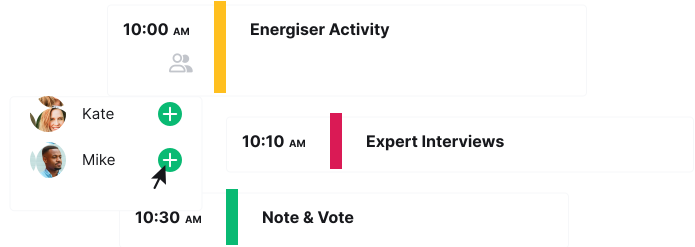
In SessionLab, you can use color-coded activities to get an easy-to-see visual overview of your learning flow and see how different types of activities are distributed throughout the session.
You can also explore the library of facilitation methods and training activities when looking for different ways to achieve your objectives.
Create a training script
Not every training designer likes to work with a script or add one to the final agenda, but in my experience, writing even a simple draft script is so helpful when it comes to working on your design.
I always do a prototype run-through with a script as early in the process as possible. I think of this as fail-forward training design. If I bore myself, trip up repeatedly or get lost in the material, that’s a surefire sign that something needs adjusting. Having this experience early means you save time and hone in on a final structure more quickly than waiting until everything is perfect.
If you do want to add a training script for other trainers to follow or adapt, SessionLab supports adding an additional column for that too. In my experience, even if facilitators aren’t required to use the training script, it’s a useful learning tool that can make it easier for them to grasp the material and deliver later.
Collaborate with stakeholders and subject matter experts
Once the first draft of your training agenda or course design is in place, you’ll likely want to seek feedback from stakeholders and collaborators before moving forward.
This may involve reviewing the content with subject matter experts, checking that activities are appropriate for the audience and ensuring the design aligns with organizational expectations.
Invite collaborators directly to your training agenda in SessionLab to work asynchronously or in real time, leave comments and iterate on the design together. Here, you can have SMEs add training resources and critique designs while maintaining a single version of the training program that everyone can find.
There’s much more to say about designing training agendas, so if you want to explore this stage in greater detail, check out our guide to creating an engaging training agenda.
6. Plan your learner assessments and evaluation methods
As your training program takes shape, you’ll also need to get clear on how you’ll assess learning and evaluate its effectiveness.
In many cases, your assessment criteria will emerge naturally from your training needs assessment and learning objectives.
A common training design process can be simplified into three questions:
- What do we need to teach our trainees? (Learning objectives)
- How will we know they’ve learned it? (Assessment criteria)
- How will we teach them that? (Learning activities and methods)
I say process, but it’s probably more accurate to consider this a loop. Choosing your assessment methods can inform your training techniques or even call into question exactly what you’re teaching in the first place.
For example, if your learning objective is to help managers conduct effective feedback conversations, asking participants to complete a multiple-choice quiz may help assess their knowledge of feedback principles.
However, it won’t necessarily demonstrate that they can apply those principles in a real conversation. In this case, a role-play or observed practical exercise might be a more appropriate assessment.
There are generally two kinds of learning assessment worth considering.
Formative assessment takes place throughout the training program and helps you understand how participants are progressing. This might include quizzes, discussions, practice exercises, reflection or informal feedback.
Summative assessment takes place at the end of a learning experience and evaluates whether participants have achieved the intended learning outcomes. Examples include tests, presentations, practical demonstrations or completed projects.
Depending on your program, you may use a combination of both.
7. Develop and review additional training materials
Once the structure and activities of your training program are largely finalized, it’s time to develop the materials needed to bring the learning experience and support trainers to life.
Depending on your training format, this might include slide decks, videos, eLearning content, worksheets, practical exercises, participant handouts, job aids, assessments and other supporting resources. You’ll also need to prepare any instructions, materials and logistical information required to deliver the training.
For instructor-led training, I’d recommend bringing everything together in a comprehensive facilitator guide. This provides instructors with a detailed agenda, activity instructions, slides and supporting materials in one place, making it easier to prepare and deliver the training confidently.
For more advice, check out our guide to creating effective facilitator guides, or explore this ready-to-use feedback training facilitator guide template to see what a completed guide looks like.
Review your materials before delivery
Before finalizing your materials, I’d recommend reviewing them from multiple perspectives. SMEs are especially important here, though I often reach out to a trusted co-facilitator, someone in a community of practice and even a potential participant. These extra eyes can let you know whether you’ve hit the mark.
Are the instructions clear? Are all the necessary resources included? Could another instructor confidently deliver the training using the materials provided?

In the case of instructor-led training materials, I’d also recommend printing your training materials ahead of time and do a mock run, even if it’s just for you. I’ve learned so much from actually walking around a room and giving a handout to an empty chair or standing in front of a slide deck and rehearsing what I’d actually say to participants.
Pilot your training before rolling it out
For larger training programs and especially those you expect to run at scale, I’d recommend testing the learning experience with a smaller group before delivering it more widely.
A pilot gives you an opportunity to see how the program works with real participants and identify problems that aren’t always obvious during the design process.

Rather than simply delivering the training and asking whether participants enjoyed it, I’d recommend identifying what you want to learn from the pilot beforehand and finding opportunities to get into the weeds with particularly engaged participants.
You could use a simple review like this:
| What to review | What to look for |
|---|---|
| Timing | Did activities take longer or shorter than planned? |
| Content | Was anything too basic, too advanced or unnecessary? |
| Engagement | Where did participants actively contribute or disengage? |
| Instructions | Did participants and trainers understand what to do? |
| Learning objectives | Could participants demonstrate the intended skills? |
| Materials | Were any resources missing or difficult to use? |
Try to select pilot participants who are representative of your intended audience, rather than exclusively inviting employees who are already enthusiastic about the subject. Collect participant feedback through Forms and use the results to inform revisions.
If possible, I’d also recommend having someone observe the pilot and record notes on the learning experience. In the case of some light programs, this might be overkill. If you don’t have the time or capacity for a pilot, I’d always recommend a session run-through or even a high-level walkthrough, preferably with someone else in the room.
This should also include a process of testing the tech and materials in a live environment: every input form, eLearning module, printout and facilitator guide.
8. Deliver and scale your training program
After all this work researching, designing, developing and reviewing your training program, it’s time to put it into practice and deliver it to your participants.
Exactly what this stage involves will depend on the type of training you’ve created.
For a self-paced online program, delivery might involve publishing content, enrolling learners and making sure they have the information and support needed to complete it.
For instructor-led training, you’ll need to prepare your trainers, coordinate logistics and potentially lead sessions yourself. Here are a few important things I’d recommend keeping in mind at this critical stage.
Prepare your trainers and learning environment
If your training program will be delivered by other instructors, it’s essential that you arrange a sync meeting or walkthrough meeting before delivery. Even if your facilitator guide has all the info needed, I would never skip this step. Making connections with other trainers, underlining key points and creating an opportunity for dialogue often helps the team feel supported and more able to deliver the materials.

Of course, you’ll also want to provide access to all the materials needed to run the training program. Share your facilitator guides and supporting materials in SessionLab if you haven’t already and double-check any room bookings or technology needed for delivery if this is your responsibility. The key here is ensuring trainers have everything they need and that any logistics are all ready to go.
Match the right trainer to every delivery
Once a program runs regularly, deciding who delivers each session becomes a real part of the coordinator’s job.
If you don’t already have one, I’d recommend keeping a shared record of all the trainers and facilitators in your organization, including what they’re certified for, languages, location, availability and anything else you might need to match them to training work.
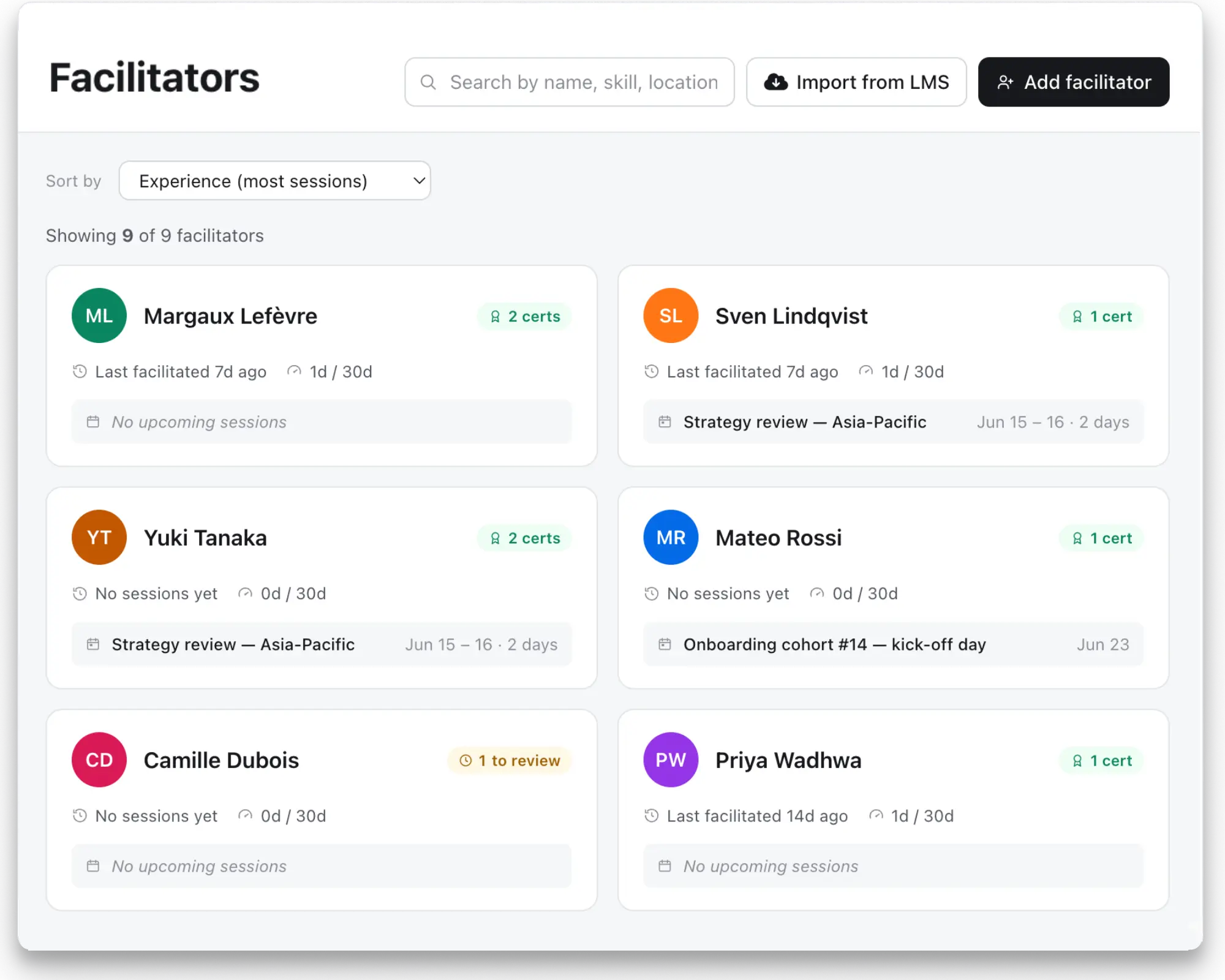
Before inviting anyone, agree on the roles each delivery needs, such as a lead trainer and a co-facilitator, and write a short brief covering the audience, dates and format.
When managing instructor-led training in SessionLab, use Session Requests to host your trainer pool next to your sessions, so you can invite trainers to specific roles and easily coordinate assignment and pool capacity.
For more advice on the delivery stage, explore our guide to creating and delivering engaging training sessions.
9. Collect feedback, measure impact and improve
By this point, feedback should already be built into your program. You agreed on success measures with stakeholders in step 2, created your feedback form alongside your session design, and tested both during your pilot.
The challenge now is keeping that feedback useful once the program is running regularly, often with several trainers delivering it to different groups.
Collect feedback at the right moments
A single survey at the end of a session tells you how people felt in the room, but not what they do back at work. For most programs, I’d recommend planning a sequence of feedback points like this:
- Before the program: a short baseline survey asking participants to self-assess on the skills or behaviors you’re targeting. Without a starting point, it’s hard to show what changed.
- At the end of each session: reaction feedback while the experience is fresh, plus a moment for participants to note what they’ll do differently. Those commitments give you something concrete to follow up on.
- 20 to 30 days later: a short check-in asking participants how they’re applying what they learned. Research from Actionable suggests that regular reflection in this period makes behavior change more likely to stick, so the check-in is part of the learning as well as the measurement.
- 30 to 60 days later: observable signals from managers or peers, and any movement on the indicators you agreed in step 2.
- 3 to 9 months later: the business outcomes your stakeholders care about, checked whenever those metrics are normally reported.

I’d also recommend scheduling these follow-ups before the program runs. In our State of Facilitation report, 43.5% of respondents said a lack of follow-up conversations was what most gets in the way of lasting impact. Follow-up that sits on a to-do list rarely happens.
Keep feedback consistent across trainers
Once several trainers deliver the same program, consistency matters. If one trainer rewords the questions and another forgets to share the form, you’ll end up with plenty of feedback but no reliable way to compare deliveries.
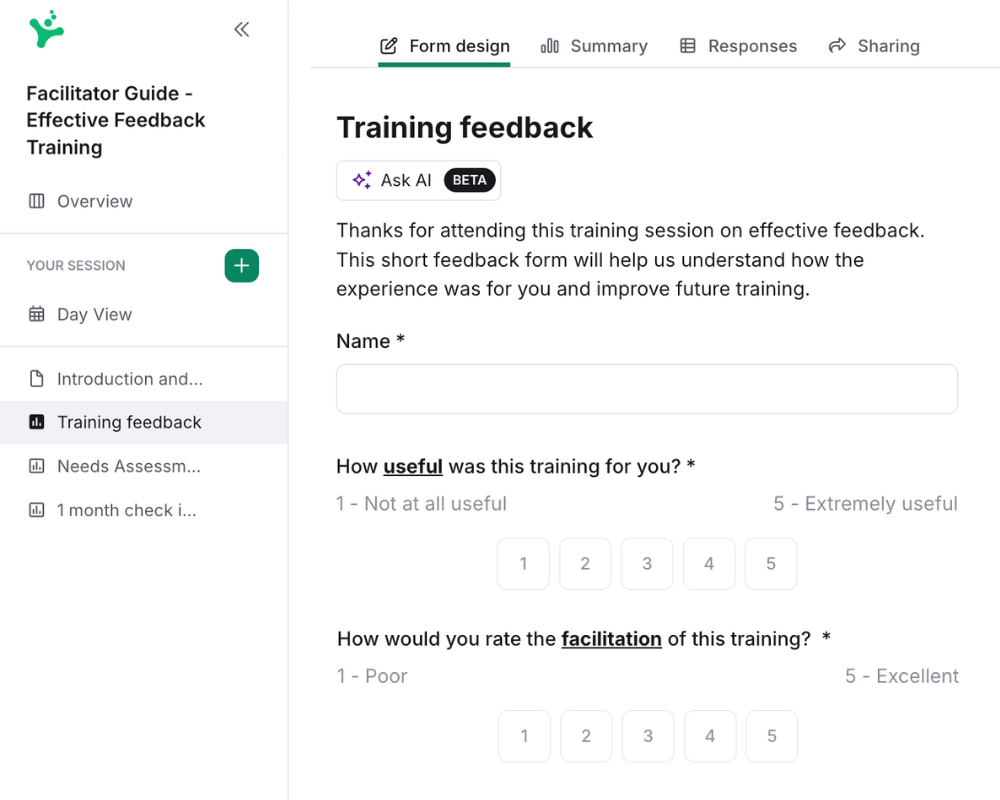
Keep the core questions you tested in your pilot the same for every delivery, and share the form in the room with a QR code or link rather than by email days later. It also helps to know which delivery and which trainer each response came from. Low scores for relevance usually point to a design issue, while low scores for clarity might be about delivery or the facilitator guide.
In SessionLab, you can set up standard feedback form templates for your workspace. Each session gets its own copy, so feedback stays tied to a specific delivery while you compare results across cohorts and trainers.
Close the feedback loop
Collecting feedback is the easy part. In larger programs, it often ends up in a report that trainers never see and designers never act on.
A participant survey can tell you whether a session felt useful, but not why an activity fell flat. So just as you did during your pilot, make time for your own reflections and those of other trainers after each delivery. Did the training flow as intended? Did participants struggle with any concepts? Where did you need to adapt the plan?
Then set a regular point, perhaps once per cohort or once a quarter, to review feedback across deliveries and decide what to change. Update the master version of the program rather than one trainer’s copy, so every future delivery benefits, and let your trainers know what changed and why.
Share trainers’ own results with them as well. If someone is struggling with a particular module, pairing them with an experienced co-facilitator is often more useful than any survey score.
If you mark delivered sessions as closed in SessionLab, you get a record of who delivered what and when, which makes it easier to connect feedback trends to specific trainers and deliveries.

Measure the impact of your training program
Finally, return to the success measures you agreed in step 2. Did the program close the skills gap you identified? Are participants demonstrating the behaviors you wanted to develop?
If you’re familiar with the Kirkpatrick model, most programs handle the first two levels (reaction and learning) well. Behavior and results are harder, because the evidence lives back at work, weeks or months after the training. That’s why the later check-ins above matter so much.
Where outcomes are hard to measure directly, proxy indicators help. These are observable signals, such as fewer escalations or faster onboarding, that you’d expect to see if the learning transferred. The key is agreeing on them before the program starts, not after you’ve seen the results.

Measuring business impact takes time, and it’s rarely possible to link organizational improvements to a single training program. But making the effort, and feeding what you learn back into the next version of your program, is what turns a good training program into an effective one.
For a deeper look at this stage, see our guide to measuring training effectiveness.
Using SessionLab to design and run training programs
SessionLab is built for L&D teams who design and deliver instructor-led training at scale. It brings program design, trainer coordination and feedback together in one place.
Design once, deliver consistently. Build program outlines, session agendas and facilitator guides with your SMEs and trainers, then save them as templates, so every delivery starts from the latest approved version.
Staff every session with the right trainer. Keep your trainer pool alongside your programs and invite the right people to each delivery with Session Requests.
Improve with every delivery. Attach feedback forms to every session and review results across trainers and cohorts to decide what to change next.
See how it works in this 3-minute video on scaling instructor-led training.

Final thoughts
Creating a training program that actually drives behavior change doesn’t happen by accident. A solid, repeatable design process combined with human judgment is what’s needed to turn a training request into something that creates lasting impact.
We hope this guide has given you a sense of the end-to-end design process, as well as practical tips for each step along the way. When it’s easier than ever to pump out training content, quality and engagement are at risk. In our view, it’s even more important that training designers and program coordinators find more efficient ways to deliver training while preserving what makes learning experiences deeply human and effective.
If you’re ready to put this into practice, start with a training design template, or see how Norconsult uses SessionLab to deliver leadership training at scale. To explore how SessionLab could support your training operations, get in touch with our sales team or get started for free.

James Smart is Head of Content at SessionLab. He’s also a creative facilitator who has run workshops and designed courses for establishments like the National Centre for Writing, UK. He especially enjoys working with young people and empowering others in their creative practice.


Leave a Comment