How to plan a team offsite: a complete guide

Planning a team offsite is a big responsibility. You're managing logistics (venues, travel, catering, schedules), balancing needs, and designing an experience that people are going to give their time, energy, and trust to.
This guide is designed to help you plan and deliver a company offsite where teams truly connect, decisions are made, and where the team goes back to regular work with purpose and energy.
You’ll find practical planning advice, example templates and insights from our years of running team offsites at SessionLab.
A team offsite is about more than getting everyone in your company together in a nice hotel for a few days. A good offsite creates the conditions for meaningful work, improved connections, and change. But what separates the effective retreats from those that fail to move the needle?
A common failure mode isn’t a logistics disaster (though this happens too). It’s an offsite that runs smoothly and changes nothing. Sessions that feel productive but produce no decisions or action points. A team that leaves energized, then falls back into the same patterns within a fortnight.
Or the reverse: an offsite that exposes real friction in the room but has no structure to move through it, leaving people more unsettled than when they arrived. Both outcomes often share the same root cause: a design that was not clear in its purpose.
In this guide, you’ll find a practical framework for planning your next offsite, going from a brief, to a proposal and ending with a design that sets the stage for a productive and memorable retreat.
Why run a team offsite?
Bringing your team together, stopping regular work and spending money on a great venue and facilitation team is a big commitment. So why do it?
Most teams are pretty good at getting things done. But this doesn’t always create space to step back, think about whether you’re working on the right things, or improve how you work together or surface underlying tensions.
A well-designed offsite creates the conditions that normal work doesn’t. Getting people out of their usual environment to work towards a shared purpose can have a transformative effect on getting things done. Cross functional teams break out of silos. Longterm problems can be discussed in a safe container. Decisions get made.
There’s also growing evidence that in-person collaboration drives a different quality of thinking: a 2023 study found that co-located teams were significantly more likely to produce disruptive, breakthrough innovations, while distributed teams tended toward incremental progress.
In our increasingly distributed and busy world, focused events and team offsites create the container for real impact and change.

When is the right time for a team offsite?
The honest answer is: sooner than you think, and more regularly than most teams manage.
Teams that wait until there’s an obvious crisis to bring people together tend to find the offsite much harder work than it needed to be. The trust deficit is larger. The tensions are more entrenched and strategic drift may have widened. Using offsites as a regular practice instead of a crisis response is often what produces the most value over time.
That said, some moments are particularly worth acting on:
- When the team is unclear on direction or priorities. If people can’t independently name the top three things the team is focused on, or if different people give different answers, that’s a signal.
- After (or at the start of) significant growth or change. A re-org, a wave of new hires, a change in leadership, or a strategic pivot can be a compelling trigger for a team offsite.
- When trust or communication has broken down. If teams are working with low trust, poor communication or other collaboration challenges, it might be time to bring them together to resolve things.
- Beginning or end of a period of work. The start of a new financial year or quarter, the end of a major phase of work, a moment when the business is making a significant decision.
- On a regular cadence, regardless. Even when things are going well, getting together in one space can have a powerful impact.
The data backs this up: Emburse’s 2025 State of Corporate Offsites report, based on a survey of 2,000 employees, found that companies exceeding their financial targets host offsites more frequently than underperforming ones, and have significantly more engaged employees as a result.
A practical starting point for most teams is once a year at minimum for a full-team reset, with an additional session half way through the year if work and budgets allow. At SessionLab, we’ve found having team retreats on a six-monthly (ish) cadence works well for us.
Team offsite templates
Below, we’ll explore a complete step-by-step process for planning a team offsite from start to finish.
If you want to jump ahead, here are a few different offsite agenda templates you can use as the basis for your next planning process.
- 1-day offsite agenda designed for small to mid-sized team offsites.
- 2-day corporate offsite template, designed for 100+ participants.
- 4-day offsite agenda with hackathon and Open Space Technology day.

Step 1. The team offsite brief
The best team offsites have a clear reason for bringing everyone together. Defining your purpose, and understanding the needs of the team is where any offsite planning process should begin.
In practice, this means slowing your stakeholders down and asking questions they may not have asked themselves. Why exactly are running this offsite? What does success actually look like, two weeks after people go home? What are the outcomes that matter but are harder to name: the trust that needs rebuilding, the decision that’s been avoided, the shift in how two teams relate to each other?
Skilled facilitators distinguish between two kinds of outcomes when briefing a session. Tangible outcomes are the concrete deliverables, the strategic priorities ranked, the roadmap agreed, the ways of working documented. These are the things that relate directly to your business goals and play a key part in determining the key working sessions of the offsite you will run.
Intangible outcomes live in the world of communication and connection. These include increased trust, renewed energy, a shared sense of direction or alignment. How do you want participants to feel as a result of the company offsite. These “soft” outcomes are as real and important as your deliverables and should be named in order to influence your design and be present in the final offsite.
Questions to ask while creating your offsite brief
- Why are we meeting in person, and why now?
- What are the non-negotiable outputs?
- Who must be in the room, and who is optional?
- What are the constraints? (time, location, existing commitments, etc.)
- How will this be useful to the business?
- How will this be useful to participants on a personal level?
- How will we know it was a good use of time two weeks or a month later?
Once you have answers to these questions from senior stakeholders, you have the beginning of your offsite brief. Structuring the outputs into a simple document or Page in your session will help you at every stage of the planning process. It can be especially useful to share this with collaborators and other folks involved in consulting in the design and running of the offsite.
Find an example of this brief alongside an agenda in this team offsite agenda template.
Getting input from participants
After your conversation with major stakeholders, it’s time to get some input from the wider group of people likely to attend.
At this early stage, it’s worth talking to a cross-section of participants across different seniority levels and functions. Ask them what they’re hoping to get out of the time together. Ask what’s been difficult lately or where meaningful progress needs to be made. Ask what they’d consider a waste of time and if they have any additional needs. (Explore this subject more deeply and find pre-prepared questions in our guide to event surveys.)
Depending on the needs of your offsite, you may run a quick survey and start collecting needs and expectations in greater detail. Whatever method you choose, all of this is vital input for your offsite agenda, venue choice and more. Collect information with a SessionLab form or keep notes next to your agenda to easily inform everything that follows.
Need a little more guidance on getting everything you need from your stakeholders? See this guide to workshop planning to see a sequence of meetings that will help you get there.

Step 2. The logistics layer
Behind every great offsite is someone managing all the logistics needed to make it possible. That means arranging a venue with the right rooms, figuring out transport options that don’t leave half the team stranded, and organizing a dozen other details that feel invisible when they go right and catastrophic when they don’t.
In this section, we’ll cover everything you need to think about when putting together an offsite. From venue and location, through to budget, catering, and other logistics.
Organizing many of these items needs to start at an early stage, though it’s worth noting you’ll be working through many of these details throughout the process and alongside designing your agenda. Expect some deep project management work, lots of conversations and holding responsibility for getting everyone into the room on time.
Choosing an offsite venue
The venue is the container for everything you’re going to do on the offsite. It’s vital that the venue is chosen with intention and ideally, it should be decided upon very early in the planning process.
In our experience, you’ll want to scope out potential venues 6-9 months in advance, pining them down and booking once the participant number and scope of the offsite has been decided. But what are you looking for? Let’s dig in.
The non-negotiables:
- Proximity to transport. Aim for a venue within 60 minutes of a well-connected airport or major transport hub. Someone will have an early departure or a late arrival. Distance compounds stress, especially if there’s a complex travel chain. A notable exception to this rule is if you’re hosting in a spectacular but isolated venue, though be sure to design your agenda accordingly.
- Working space. For small offsites of under 20 people, you’ll typically need an absolute minimum of three separate spaces: one main room that fits everyone, a separate breakout room to use during small group work, and an informal lounge area for the gaps.
The ideal is for more spaces for small working groups and meetings, though its also possible to improvize, use outside spaces and split larger rooms up when needed. What’s key is that participants have room to spread out and enough distance working groups won’t be talking over one another.
Hotels, resorts and conference centres are a natural pick if you have more than 20 people attending and you need to host and accommodate them all. - Natural light. Windowless rooms are energy killers by mid-afternoon. Prioritise natural light in the main working space wherever possible and think about what it will feel like to attend the offsite. Grey, sunless rooms can often contribute to grey, sunless outputs. If you can get somewhere with easy access to outside space, even better.
- Comfortable temperature. In a large international hotel, this is a given, but if you are renting a villa or some smaller local accommodation, make sure to check that the heating or air-con are suitable for your folks to comfortably work.
- Overnight accommodation. If staying onsite, confirm individual room arrangements carefully. People should have their own space to decompress, relax and retire. While they may work for scrappy early stage teams, shared rooms can be a source of friction (or simple lack of sleep) that carries into working sessions.
I’d also recommend not just choosing the cheapest option. Offsites are expensive, yes, but going above the bare minimum on hotels can help people feel like their time and effort is being respected. Being away from home can be hard: a decent room helps ease that feeling and can be a lovely way to show your gratitude for your team. - A space that fits everyone. For plenary moments, photo ops, informal gatherings and big team activities, you’ll need somewhere big enough to make that happen. You may be able to use public spaces in a pinch, but if large spaces are integral to your agenda design, you’ll want to ensure your venue can support this.
The nice-to-haves:
- An outdoor space or nearby area for walks. At SessionLab retreats, we typically aim to find venues with their own outdoor space to allow folks to touch grass, take a breath or even work outside. A nearby park is also an option that creates a natural way to take space and take a break.
- A bar or lounge area. Where will people hang out after the working sessions? It is quite likely that there will be some after-work socializing, so figuring out where it will take place is important here.
- Flexibility in room configuration (cabaret vs. boardroom vs. open space). We’ve all had to make do with a room with not enough chairs or where certain activities won’t work. Finding a venue with a mix of room types and sizes allows for flexibility in facilitation. (See more on this in our room setup article.)
- Food onsite. Being able to eat at or close to the venue can really help your working sessions run smoothly. Hotels are great for this, though booking a caterer is an option too. Its likely that you’ll want to book a couple of restaurant visits (or do a team cooking session) but ensuring your team can stay focused and not have to stress about cooking breakfast can ease the mental load throughout the offsite.
For any offsite more than a day long, the ideal is to use a hotel, villa or other such location where your team can stay onsite. If this isn’t possible, at least ensure that your working location and accommodation are within short walking distance.
In my experience, choosing the perfect venue goes hand-in-hand with your offsite agenda design. Having a rough overview of what you’ll be doing and with how many people can crucially shape your choice of venue. If your organizer and lead facilitator are different people, be sure to communicate well at this early stage!
Once you’ve confirmed your venue, build your working spaces directly into your agenda in SessionLab. Note which sessions are in which rooms and list setup requirements per session. When co-facilitators or venue staff need to prepare, the plan is already there and they can see materials, instructions and timings in one place.

Collecting what you need from participants
Running the team retreat smoothly is often an accumulation of small requirements and logistic information. Run a pre-retreat survey 1-3 months in advance in order to collect all those bits of information you need to book rooms, meals and ensure accessibility needs are met. You will likely ask for information on the following subjects:
- Dietary requirements. Collect these early and pass them to the venue with enough lead time for alternatives to be arranged. A simple form asking for allergies, intolerances, and strong preferences is worth sending 3–4 weeks out.
- Travel details. For multi-day offsites, knowing when people arrive and leave matters for your agenda design. Someone landing late at night might not be ready to engage deeply at 8am the next morning.
- Accessibility needs. Ask proactively and create space for your team to surface their needs.
- Room preferences. If participants have preferences (single rooms, floor, etc.) it’s easier to handle these before booking than after.
- Anything else we should know. Giving participants space to share anything else is always a good idea. While you may have some pre-work that captures work-related items, asking within this frame can surface other needs such as personal issues that can impact their ability to be present.
- Session/social time preferences. If you’re planning social events and leisure time, it’s worth asking for preferences so you can book that escape room, local food tasting or historical tour in advance.
Where possible, keep all non-sensitive information somewhere accessible to the team. In our experience, this is useful to teams organizing taxis from the airport, synchronizing excursions or for any last-minute restaurant bookings.
Send a survey with SessionLab and then ask the AI assistant to summarize responses or turn the output into a simple table alongside your agenda is a fast and effective way to source this information and make sense of it too.
Keeping this in one place means anyone on the team can quickly find what they need without endlessly asking the lead organizer (though this will still happen!). All the information your participants provide is also vital input for your agenda design and to help prepare any co-facilitators too.

Offsite catering
Whenever I attend an event or company retreat, one of the things which has a profound impact on how our group feels and functions is the food.
If food is good and available on-time, people are buoyant, sessions run on time and people have enough fuel for the work ahead. If food is bad or arrives late, people get grumpy, energy levels get low and the agenda often needs adjusting. Here’s some things to think about:
- Breakfast: if you’re asking people to work by 9am, make sure they can eat before that. Know your venue’s breakfast service times and prepare your agenda for a little overspill. I’m yet to go to a retreat where everyone makes it back from breakfast by exactly 9am sharp.
- Coffee breaks: Budget time for proper breaks in both the morning and afternoon. Where possible, arrange for snacks and coffee to be provided by the venue at the allocated time. This means less time trying to find sustenance and more time taking that much-needed walk or comfort break.
- Lunch: Anything less than an hour for lunch can feel like a rush. People often use this time not only to eat, but to decompress, take a little alone time and connect in small groups. Bake this into your agenda, as it’s a vital part of what makes those afternoon sessions run more smoothly.
- Dinners: Dinners are a great way to open, close, and mark special moments for your team. Where possible, invest some effort in planning something that will lift the team and create a memorable experience.
- Between sessions: keep water and (preferably some healthy) snacks accessible throughout the day. Hunger is a concentration killer and people often run on different internal clocks: make it easy for people to put fuel in the tank and stay present whenever the need strikes.
- Healthy/alternative options: having fruit, vegetables and alternative options available without folks needing to ask is a great sign that the event organizer is paying attention and thinking about participant needs.
- Dietary requirements: As you’ve already collected any requirements, this should be easy, but ensure that any caterers, restaurant choices etc provide for those with dietary needs. Note that having a single vegetarian option every night of a retreat isn’t good enough.
It’s also worth noting that all of this information should be readily available (whether in a briefing document, in your SessionLab agenda or elsewhere) but also expect to repeat times for lunch and breaks throughout the retreat.
Materials and room setup
Beyond choosing an appropriate venue, you’ll also want to ensure that each working space has everything the team needs for the sessions being run.
For workshop-style sessions this often includes.
- Flipcharts and notepads (one per breakout group minimum)
- Sharpies / markers in multiple colours (thicker than standard pens, thinner than flipchart markers)
- Post-it notes: larger sizes are more readable; multiple colours help with categorisation
- A4 paper
- Enough pens for everyone
- A projector or large screen with HDMI/wireless connection confirmed in advance.
Confirm what the venue provides and what you need to bring. Do this at least a week or two before and ask any facilitators or session leaders to provide their material/room needs directly in SessionLab, so your lead organizer can arrange accordingly.
It’s also worth getting clear about who is bringing what and whether any slide decks, posters or printouts are needed. While some venues may have printing available, many will not, and ensuring that your team knows what’s needed before getting on the plane can help ensure a stress-free flight!

Thinking about your team offsite budget
Before any venue is shortlisted or agenda drafted, someone needs to set the budget, scope options and get it approved. Budget shapes every downstream decision: how far you can travel, how many nights you can afford, whether you hire an external facilitator, and how much social time the event can hold.
In some cases, you may enter the offsite planning process with a budget already decided. Great: plan within your means! On other occasions, this budget may be fluid or be dependant on the proposal you put forward.
The main cost buckets to think through:
- Travel and accommodation. Often the largest line item, especially for distributed teams. Factor in flights, ground transport, and individual rooms for every night onsite.
- Venue and working spaces. Hire costs, AV equipment, breakout room availability. Some venues bundle these; many don’t. Get clear on this early and get a quote from the venue team.
- Catering. All meals, breaks, and evening dinners for the duration. Budget for dietary alternatives and for the fact that offsite meals can fluctuate and can cost more than you expect.
- Facilitation. If you’re bringing in an external facilitator or consultant, this needs its own consideration. You might find our guide on hiring a facilitator helpful for making a case for facilitation and figuring out if you should go this route.
- Social activities. Team dinners, experiences, any optional social programming. There is such thing as too much “organized fun”, but doing something special can help lift your offsite from good to exceptional.
- Materials. Flipcharts, post-its, printed agenda packs, any workshop supplies you can’t source on-site.
Before you finalize your offsite agenda, you’ll need to synthesize the information you’ve received and share a proposal with major shareholders. You’ll take the input from leaders and other team members, consider all the information collected for your brief and create a short proposal or concept draft.
This will likely include:
- A summary of desired outcomes and the primary purpose of the offsite
- A list of benefits for participants and the organization
- A draft list of attendees
- Venue considerations and a few proposed locations
- Suggested dates, times and duration
- A simple overview of the main working sessions and structure of the offsite
- Budget and approximate costings
In SessionLab, this works best when creating a skeleton agenda supported by a simple proposal page. With a simple, visual overview, it’s easy to tell the story of the retreat and make your proposal legible.
Give your stakeholders a sense of how the offsite hangs together, even if many aspects of your agenda aren’t yet pinned down. If your team needs to see a little more detail, you’ll find lots of advice for creating an effective offsite agenda in the next section.

Getting offsite approval
After presenting your proposal to key stakeholders, a few things will likely happen. Some additional considerations will surface, some changes may be suggested and slowly, you’ll move towards an amended design that gets approval.
At this stage, expect the general shape of the offsite to be set, giving all involved enough to proceed with designing the agenda, arranging the venue and communicating to the team.
For some organizations, there may be a need to talk about expected impact in both soft and more concrete terms. Answering these questions can be a challenge.
Be prepared by getting clear expectations about what is needed at this stage before you begin your proposal and ask key stakeholders for input where you can. Use feedback and impact metrics from previous retreats and interventions to bolster your case.
Be honest about what you don’t yet know, but have a clear idea of how you’re going to find out. For example, consider how you will evidence the value and impact of the offsite, perhaps using some of the insights from this guide to high-impact facilitation.

Step 4. Designing the offsite agenda
A good team offsite truly begins to take shape once you start designing the agenda. This is the structured design that moves a group through a flow designed to make the best use of your time together.
From arriving and getting oriented, through deep work (and play), to making clear commitments and having a closing ritual that sends your team back into the world refreshed and ready to do great work. Here’s how to design an effective team offsite agenda.
Start with must-haves, not wish lists
Before you start placing sessions, ask a more fundamental question: what are the must-haves, and what are the nice-to-haves?
Every offsite agenda starts with more good ideas and tasks than time. The instinct is to try and fit everything in to ensure results. The outcome of this approach can be a schedule so dense that there’s no room for the actual work to breathe.
A more useful approach: before you build the agenda, go back to your brief and note everything that is needed in order to achieve the purpose and outcome of the offsite.
Typically, achieving your desired outcomes will require a series of actions to be taken as a group. From orientation and presentations, to exploration and ideation, to finally to making decisions and choosing next steps. Those actions, and the order in which they happen, form the blocks that make-up your agenda.
(See this post on how to run a group decision making process for a deeper exploration, including Sam Kaner’s diamond of facilitation.)
Every facilitator has a different approach to designing an agenda and reading this, you might already have a favoured structure or framework. Great! Using what you know is often the best way.
If you’re looking for a simple alternative, here’s how I like to think about structuring events and offsite agendas that can help me move from a list into something that helps me meaningfully start designing the flow.
- Identify key blocks of time. Every day has two large blocks of time. Before lunch and after lunch. These themselves are separated by a break somewhere in the middle. So you have four working blocks of around 90-minutes each.
- Insert non-negotiables and fixed times. Next, take those things you know absolutely have to happen in order to achieve the purpose set out in your brief and start putting them into these working blocks in the order that makes sense.
- Place your key pillars in a lgocial order. Early in the process, its likely that you’ll have some major topics which form the central pillars of your offsite. Big presentations, opening statements, discovery workshops, training sessions, deep work. Some of these will fit neatly into a single working session while others will take 2-4. Getting your most important things in place first will show you what you have to work with and allow your schedule to flow naturally around them.
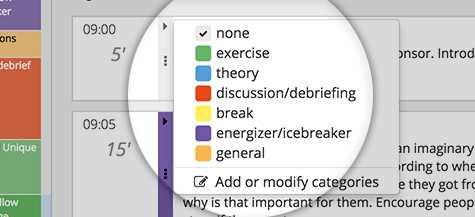
At this stage, it can be useful to add notes and instructions to your SessionLab agenda, set approximate timings and colour-code your key blocks. All of this means your agenda can begin to take shape and it’s easier to overview, either for your own needs or those of a co-organizer.
See this simple 1-day team offsite template to get a clearer picture of how this looks in practice.
Creating flow
Once your major blocks are in place, you likely have the rough shape of your offsite in place. Now is the time to create flow and turn this structure into a real event.
Typically, this means doing a few editorial passes on your agenda to ensure its fit for purpose. Here’s some of the things I look for during the drafting process.
- Opening sections. Have you created time to welcome folks to the retreat, get them oriented and create space for discussing expectations and objectives at the start of the offsite?
- Closing sections. How will you close the working sessions effectively?
- Transition sections. How are you transitioning between different kinds of work? Are you providing different forms of engagement to help with energy levels and flow?
- Moments of connection. Good facilitators know all about creating connections before jumping into content. In a lengthy offsite, it’s helpful to go further, creating multiple opportunities for inter-team connection throughout the agenda.
- How are parallel sessions structured? Will these teams have an opportunity to share what they’ve worked on with other teams? When?
- Do the working sessions create a natural sense of momentum and flow logically? ie. Are we asking people to design solutions before we’ve truly explored the problem?
- Is there thinking time as well as doing time? When we invite people to take in new information, how are we creating the conditions for that information to land, gestate and then transfer into action.
- Have we thought deliberately about participant energy levels? Perhaps we put harder cognitive work in the morning, relationship-building and reflection in the afternoon/evening.
- Is the design inclusive for folks with different learning styles and preferences?
One of the things that starts to emerge at this stage is flow. Either your offsite has it already (lucky you!), or things will feel a little disjointed or incoherent.
For me, designing for flow means having a general structure down and then reviewing it with the mindset of someone attending. Imagine yourself during these sessions. What questions would you have that are currently unanswered? Would 4 hours of presentations to end the day make you feel engaged or not?
At this stage, it’s worth inviting a key stakeholder or a trusted editor or co-facilitator to review your SessionLab agenda too.
During this process, you’ll likely liaise with any co-facilitators, team leaders and those people organizing the venue if that person is not you. This is integral for ensuring you have enough time scheduled for tasks and that you have the right space to run your intended design.
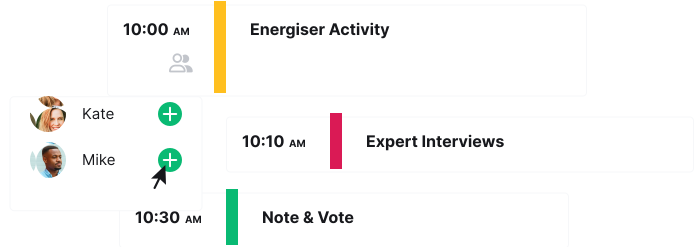
Ask these folks to leave comments on specific blocks in your session or tag them for key input in your SessionLab agenda directly to keep things organized. By inviting collaborators to your session and iterating in one place, you can avoid sending document versions back and forth and maintain a single source of truth for all involved.
Refinement and the (almost) final draft
The process of refining your agenda can take weeks. You may be waiting for confirmation from the venue, external contributors or internal stakeholders before you can finalize some aspects of the offsite.
In my experience, it’s also good practice to put the agenda away for a little bit and avoid looking at it, if only for a few days. If you have time, coming back with fresh eyes and some input from others can often transform an event from good to great. Try to give yourself this time by creating your first agenda draft early and allowing time and space to reflect before editing.
When you do come back to your agenda, what are you looking for? Now is the time to think beyond the working sessions (if you haven’t already), nail down the flow and add those little touches that will elevate the event into something truly memorable and worthwhile.
Most importantly, you are also looking to see whether your design matches the purpose of your offsite. Have you designed a process that will meet your aims? Go back to your brief, your interview material and any needs requests you received. Be critical of whether your agenda speaks to your needs and the objectives of the offsite. Here’s some questions to ask yourself at this stage:
- Will this offsite design achieve its purpose?
- What will the benefits of attending this offsite be to those attending? Think about those tangible and intangible outcomes we explored earlier.
- How are we opening and closing the offsite?
- Have I catered to the needs of everyone in the group?
- Am I excited to run/attend this offsite?
- What am I worried about? What can I do about it, if anything?
- Have I followed best practices and designed for engagement?
After a round or two of editing, getting feedback and making adjustments, you should arrive at an offsite agenda that will pave the way for an effective, engaging session.
It’s worth noting that many aspects of your offsite are subject to change, and things can happen on the day to upend some of these plans. That’s a normal part of facilitation. The key is having a plan that provides a process you can be confident in, even if some of the scaffolding falls away or things need to change in the moment.
This is one of the reasons for ensuring your brief and intended outcomes are documented and attached to your agenda. If things radically change, you can always come back to your purpose for bringing everyone together.

Practical tips for team offsite design
Designing the agenda for an offsite can be daunting, especially if its your first time or you’re scaling for a much larger group. While the pointers above, (or the framework outlined in this workshop planning guide) will help, here are a few things to think about while designing your offsite.
Build in real buffer time
There are a lot of variables when it comes to running team offsites. Team, venue, tools, external activities, transport, weather: some of these you can control and some of them you can’t. When it comes to designing your agenda, I recommend adding extra buffer time to account for everything from technical issues, overrunning conversations and simply more time coming back from the breaks.
Packing your agenda so tight that it cannot cope with even a slight delay is a recipe for stress and spending all week trying to play catch-up. Give yourself an extra 5-10 minutes of unscheduled time where you can and add a little padding when closing or opening activities.
If there are major changes to timing, I end up going back to SessionLab and adjusting to reflect what’s happening on the day but for small delays, its so good to know that I have contingency time baked into my design.
Balance formats deliberately
A day of back-to-back plenary discussions exhausts people and systematically excludes quieter voices. When designing your offsite agenda, you’ll want to look out for opportunities to mix-up formats and session types in order to keep energy and engagement high.
In practice, this often looks like balancing your agenda for engagement. Using a mix of presentations, small-group activity, focused working time and energizing activities designed to create space for a mental break or to engage physically.
Good facilitation practice is as relevant here as it is for any other session, but there are a few more things you can do because of the increased time and space of the offsite.
Here are a few ideas:
- plenary presentations are likely, but they don’t need to be purely one-way. Use polling tools like Mentimeter to get input or reactions from the full group and display them on screens instantly to keep everyone engaged without slowing down proceedings. Small group reflections on what was shared are also very powerful ways to balance this kind of work out.
- movement is medicine and it doesn’t need to be contained to the breaks. Try pair-walks and movement based energizers to help create energy and provide a somatic transition from one topic to another.
- offsites can be intense for many people. Creating space for solo-work and reflection within working sessions can be very effective in this format. If you have a morning of intense group work, try adding activities like silent brainstorming into the mix.
- making things with our hands is a simple way to create variation and engage different parts of the brain, whether that’s simply writing on post-its, creating artifacts or paper presentations between groups. Find opportunities to move people away from screens and engage different ways of working where possible.
- Even something as simple as changing rooms or the layout of chairs and tables in a space can also have a profound effect on how a session feels. If you need to shift the energy or create space for new ways of thinking, consider changing the room layout during the break, going to a new space or if the weather allows, get outside!
- In an offsite, you often have some extra design space because of the nature of the event. Evening activities, day-to-day variations and parallel sessions can give you the scope to change things up in a way that can be extra engaging for participants.
Note that this doesn’t mean designing every minute of the evening after the working sessions. While arranging some fun after-work activities is likely, it can also be powerful to just create unstructured time for the team to do what they need to do and be together. - Having a day of open space sessions can be very effective, particularly towards the end of an offsite. Give participants room to choose their own adventure or move towards what especially interests them. It also creates space for people to have some downtime if they need it.
- Work with people’s energy rather than against it. For most people this means scheduling hard cognitive work in the morning and doing more relationship-building and reflection in the afternoon/evening. This also means considering when people are arriving and allowing them to get settled and connected before moving into deep work. If in doubt, just ask: people will tell you if they need a break or to changes things up.

Provide ample personal time (daily)
Try to build in 1-2 hours between the end of your working sessions and the evening programme. Some people will call family. Others will go for a walk, take a shower or decompress alone.
What’s important is that this isn’t just a quick break between sessions but proper personal time where people can meet their needs without feeling rushed or pressured. This is what makes sustained presence over multiple days actually sustainable and means people can do what they need to feel at their best.
Consider the rhythm of each working session
At many of SessionLab’s own offsites, we’ve found it especially useful to have parallel working sessions where teams work on things that benefit from the presence of everyone in one room. This has proven to be an effective and enjoyable use of time, but it does require intentional design.
Simply putting people into rooms and expecting them to figure things out and work effectively can result in a lot of wasted time and confusion. I would recommend structuring each working session in the format of a simple workshop.
At its most basic, this structure is a process of opening, discussing, doing, deciding and closing. Without any structure, participants can be unclear as to what’s expected, next steps may not be decided, and the working session can be unproductive.
Where possible, each working session should be led by a facilitator or someone with facilitation skills. This person may be the manager of the team in the working session though where possible, we’d highly recommend getting someone else to facilitate in these cases. Try to ensure everyone whose opinion is important to shaping the outcome of a session can focus on contributing, rather than facilitating.
One of the most effective things you can do during a multi-day retreat is something out of the ordinary which elevates the regular work around it.
At one SessionLab retreat, we dedicated day 1 to hands-on facilitation skills training. By day 2, everyone had more awareness of good facilitation practice and we could actually apply and reflect on those skills in the working sessions that followed.
On other occasions, we’ve done something physical together that has been enjoyable and memorable, such as a cooking class, mosaic workshop or a city tour. In all these cases, we’ve done something as a team that has either improved our skills or brought us closer together.
The best choice is something that speaks to the needs of your team and helps balance or compliment the shape of your offsite. Remember that even if it has no concrete business value, good times together as a team can have a profound impact on how your team works together in the future.

How SessionLab supports team offsite planning
As we’ve explored, planning a team offsite is a long process with a lot of moving parts: a brief that needs sign-off, a venue to be locked down, an agenda that goes through several rounds of feedback.
SessionLab is built to hold all of this in one place, rather than scattered across documents, spreadsheets, and inboxes. See an example in this team offsite template based on our recent offsite, including a hackathon, open space and co-working sessions.
Want to learn more? Let’s explore how SessionLab supports you in running an effective team offsite.
Your offsite brief, agenda and logistics in one place
When offsite planning starts in a doc, moves to a spreadsheet, ends up in a slide deck, and lives in someone’s inbox, it’s hard to stay organized. By the time you’re a few weeks out, no one is sure which version of the agenda is the latest or where the dietary requirements got saved.
In SessionLab, your offsite brief, draft agenda, venue notes and logistics all live alongside each other in a single connected workflow. Capture your brief, the proposal, room setup notes and any supporting context into a Page.
The agenda contains your schedule with full timings, instructions and support for parallel sessions. Add additional days in a snap and drag and drop blocks to easily adjust your session as things change. Whatever your adjust, your timing automatically recalculates so you can focus on design, not on manual timing changes.
If you’re collecting input from participants, SessionLab Forms helps you collect information and responses in the same places as your offiste agenda they relate to. No more chasing replies across email threads or copy-pasting from a Google Sheet.

Collaborate on the agenda with stakeholders and co-facilitators
A good offsite agenda goes through several rounds of feedback. Your leadership sponsor wants to weigh in on the strategy session. A co-facilitator needs to add notes to the working blocks they’re running. The venue contact needs to know which room is being used when.
SessionLab is designed for exactly this kind of collaborative drafting. Stakeholders can review the agenda in real time, leave comments on specific blocks, and suggest changes without overwriting your work. Co-facilitators can add their own facilitation notes and assign themselves to what they’re facilitating.
Team offsites are complex by nature, and the need for effective collaboration is great. Creating a shared source of truth in SessionLab means everyone is working from the same plan and can stay aligned as things change.
Templates, reuse and building institutional memory
Organizing a team offsite takes a lot of time and effort: using a template or the blueprint of a previous session can make that work significantly easier. SessionLab’s team library lets you save your best agendas, sessions and activities as templates that anyone on your team can pick up and adapt.
In practice, this means your next offsite starts from your last one. The opening session that worked, the closing ritual the team responded to, the format for the strategic alignment block: everything you make in SessionLab is reusable and can be improved each cycle. Over time, your library becomes a record of what works for your team, all organized in one place.

Clarity for everyone running the offsite
Once the offsite is running, SessionLab becomes the operational document that helps things run smoothly. Facilitators see their session notes, materials lists and timings in one view. Participants can review the agenda and select which breakout sessions they wish to attend.
Room setup requirements are attached to the sessions that need them. If something runs over and you need to adjust the afternoon sessions, the agenda recalculates as you make changes and the updated version is what everyone sees.
Going offline? Print out your session with the level of detail that works for your participants and facilitation team and give everyone what they need to contribute effectively.
In conclusion
Coming back from a successful team offsite is one of the best feelings in working life. You got great work done, connected with colleagues and made some memories. In my own experience at SessionLab offsites, we’ve done everything from AI hackathons to design sprints and culture workshops.
Putting such events together is hard work. A team offsite means getting folks together in one place and organizing the schedules of many. With the right tools and a coordinated process, it is possible to ease the burden on your planning team and run company offsites that deliver results and have people talking for months to come.
Ready to plan your next team offsite? Start for free or get in touch to see how SessionLab supports effective offsite planning.

James Smart is Head of Content at SessionLab. He’s also a creative facilitator who has run workshops and designed courses for establishments like the National Centre for Writing, UK. He especially enjoys working with young people and empowering others in their creative practice.


Leave a Comment