Starship Canvas
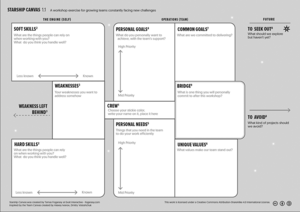
Get your team on the same page about what they're good at, what they need, covering individual skills, personal goals, team values, and concrete commitments.
Goal
Materials
Instructions
Fast facilitation (~15 min per round):Facilitator reads prompt (1 min) → Silent writing of 3–5 stickies (3 min) → Place on canvas + gallery walk (3 min) → Group discussion (8 min).
Deep facilitation (~30–35 min per round): Same start, then split into subgroups of 3–4. Individual sharing (3 min per person, 9–12 min total) → Subgroup reactions (5 min) → Highlights to full team (5–10 min).Rounds
- Crew Choose a sticky colour, write your name, place it on the canvas. Add fun titles.
- Hard Skills + Soft Skills What can people rely on when working with you? Both known and less known skills. Soft skills won't change much over time but it's interesting to see if someone writes something different next session.
- Weaknesses (Deep) Individual or shared weak spots to address. Some weaknesses will be left behind by members over time – celebrate these small wins.
- Personal Goals What does each person want to achieve, with the team's support? Goals are very different for each person and reveal what drives their creativity, work ethic and morale.
- Personal Needs What does each person need to work efficiently? Slowly shift the focus from individual to team. Small things matter: who needs a certain kind of feedback, who needs more space or silence.
- Unique Values What values make your team stand out? Summarises individual strengths on a team level and helps articulate why people like working together. One of the more important sections – spend more time here.
- Common Goals What is the team committed to delivering over the next period
- Seek Out + To Avoid What should the team explore but hasn't yet? What kind of projects should you avoid? Add subcategories like markets, industries, technologies or ethical considerations.
- Bridge Each crew member commits to 1-2 specific action they will personally do after this workshop. After commitments are set, conclude by quickly running through the main points again. A good commitment is:- Specific: "I will set up weekly 1-on-1s with each designer" – not "I'll communicate more".
Recommended: use Fast for informational rounds (Crew, Skills, Personal Needs, Common Goals, Seek Out + Avoid) and Deep for rounds that benefit from individual sharing (Weaknesses, Personal Goals, Unique Values, Bridge).
After the workshop
Review Bridge commitments at the next team standup or retrospective. At the next Starship Canvas session (recommended every 3 to 6 months), start by revisiting last session's Bridge. Celebrate what was done! Acknowledge what wasn't – no blame, just awareness.How long it takes
All-Fast (9 Fast rounds): about 2 hours for any team size.
Mixed (5 Fast + 4 Deep rounds, plus setup and wrap-up):
- 3–5 people: ~4 hours
- 7–9 people: ~4 hours (subgroups of 3)
- 12 people: ~4.5 hours (subgroups of 4)
Example schedule (Mixed, 9 people, subgroups of 3):
- 9:00 – Setup + intro
- 9:15 – Crew, Skills (Fast)
- 9:40 – Weaknesses (Deep)
- 10:15 – Break
- 10:30 – Personal Goals (Deep), Personal Needs (Fast)
- 11:20 – Unique Values (Deep)
- 11:55 – Break
- 12:10 – Common Goals, Seek Out + Avoid (Fast)
- 12:35 – Bridge (Deep)
- 13:10 – Wrap-up
- 13:30 – Done
Attachments
- starship-canvas-small-preview.png
- starship-canvas-workshop-detail.jpg
- starship-canvas-by-thomas-fogarasy.pdf
Background
Created by Tamás Fogarasy at Exalt Interactive. Inspired by the Team Canvas by Alexey Ivanov and Dmitry Voloshchuk.
Free under Creative Commons Attribution-ShareAlike 4.0.
Full article: https://fogarasy.com/writings/starship-canvas/Source files: https://github.com/fogarasy/starship-canvas
Author
I design workshops, interactive exercises and facilitation tools across education and industry. As Head of the Interaction Design MA at MOME I constantly invent new formats: critique sessions, student alignment exercises, engagement structures for classrooms and studios. At Exalt Interactive, I apply the same thinking to client projects and our own team.
I've spent over 10 years running workshops: from C-suite service strategy sessions for international brands to university courses and community meetups. I co-founded the DOERS Service Design Conference and lead IxDA Budapest.
Currently researching pedagogical patterns in contemporary AI-driven settings.