How to build an internal facilitation community of practice

A facilitation Community of Practice (CoP) is a structured group of people in an organization who recognize the value of good facilitation and want to improve their practice. It can include facilitators, learning designers, and practitioners who meet regularly to exchange knowledge, learn together, and share experiences, collectively strengthening their individual and organizational facilitation capability.
Sometimes called a facilitation hub or facilitation champions group, it sits at the heart of Level 2 in the Facilitation Maturity Model: the point at which an organization moves from isolated individual practice toward a connected, scalable facilitation function. This post covers all you need to build your own.
Here is a story about what can happen when facilitation is thoughtfully introduced within an organization, incorporating both top-down and bottom-up elements. In 2023, a team of external consultants was brought in to run facilitation training for a large pharmaceutical company. This is a typical top-down action: participants are mandated to attend because management says so.
By most measures, the training went well. Participants were engaged, feedback was positive, and the workshops delivered real results. But the consultants had seen this story end badly before: the energy from training fading as people returned to business as usual, the new skills quietly shelved. So alongside the training, they advised investing in something else: nurturing, bottom-up, a small group of internal facilitation champions. They started with five people who had shown particular interest and enthusiasm during the course.

These people received extra support and training. The consultants set up a recurrent peer coaching circle, with structured questions, which provided a welcoming space for these champions to keep meeting and supporting each other. After a couple of set-up sessions, the group became autonomous, and the external consultants were no longer needed (while remaining available to mentor and/or answer questions if required). Over the course of a year, that group grew to fourteen. And it’s the connections formed among those fourteen people, more than the training itself, that made facilitation stick.
Fast forward to 2026: facilitation practices have spread across the organization. Many more people know the basics of facilitating a good meeting; any time there is a larger strategic need, leadership knows who they can call for support. The facilitation hub meets regularly every couple of months to discuss, troubleshoot, and build on each other’s experience.
If you’re reading this, you’ve probably already seen what facilitation can do inside an organization. You may have run workshops, led training programs, or sat in sessions that changed how a team thinks about a problem. The obstacle lies in how to make that a consistent practice. How do you go from one brilliant facilitator doing great work to a culture where facilitation is just how things get done?
That’s what a facilitation community of practice is for. Let’s see how to get there.
What is a facilitation community of practice?
The term “community of practice” was coined by learning theorists Etienne Wenger and Jean Lave, and Wenger-Trayner’s introduction to the concept remains one of the clearest explanations of what makes a CoP distinct from other kinds of groups. Their definition: “groups of people who share a concern or a passion for something they do and learn how to do it better as they interact regularly.”
Communities of practice are groups of people who share a concern or a passion for something they do and learn how to do it better as they interact regularly.
Etienne and Beverly Wenger-Trayner
What makes a CoP more than just a network or a club is the combination of three elements. A shared domain (a common area of interest or practice that members are committed to). A community (people who engage together, build relationships, and learn from each other). And a practice (a shared repertoire of experiences, tools, stories, and ways of working that develops over time). Without all three, you have something else: a mailing list, a conference, a team. With all three, you have created something precious that can actually have a strong impact on how people work.
In a facilitation context, that means a group of facilitators, trainers, learning designers, and anyone leading group processes who meet regularly to share experiences, develop shared standards, and build collective capability. A facilitation CoP is a living network, not a training program. There’s no fixed curriculum, no presenter at the front of the room.
Inside organizations, you might hear this called a facilitation hub, a facilitation champions group, or an internal practice network. The name matters less than what it does: it gives facilitation somewhere to grow roots.
Why build a facilitation hub or community of practice?
Most organizations that invest in facilitation training see good results in the room. What’s harder is making those results last and making them scale.
The State of Facilitation 2026 report found that the strongest barriers to facilitation having an impact are structural: lack of follow-through, unclear goals, disengaged participants, and working cultures that make honest collaboration difficult. Crucially, these are barriers that sit largely outside the session itself. As the report puts it, improving facilitation’s impact is a shared responsibility, and it depends on whether leaders and teams create the right conditions for actions to stick.
A community of practice is one of the few structures that can actually influence those conditions. When facilitators work in isolation, designing sessions from scratch, troubleshooting alone, and reinventing the wheel, quality is inconsistent and the learning stays individual. A CoP creates the connective tissue: shared standards, collective reflection, and a group of people invested in what happens before and after the room.
Here’s what a well-functioning facilitation CoP typically delivers:
- Consistency across teams and locations. When facilitators share methods, templates, and standards, the quality of sessions becomes less dependent on any one person’s skill or experience.
- Faster development of internal talent. Newer facilitators learn faster when they have access to experienced peers, shared resources, and a safe space to debrief and reflect.
- Reduced reliance on external consultants. Every organization has different needs, and there’s real value in building people who know the culture deeply. A CoP accelerates that. External consultants should still be brought in as needed (e.g., for particularly challenging or large meetups, as well as for extra training, as we will see below), but there is a lot to be said about growing an internal talent pool.
It’s important to build local capacity. Local facilitators understand the local nuance and make it easier and more sustainable to organize without having people cross continents to deliver a workshop.
Arwen Bailey, Knowledge Sharing Advisor at the Alliance of Bioversity International and CIAT
- Psychological safety for learning. Facilitation involves making mistakes, reading rooms incorrectly, and trying things that don’t land. A CoP gives facilitators somewhere to learn in a lower-stakes environment.
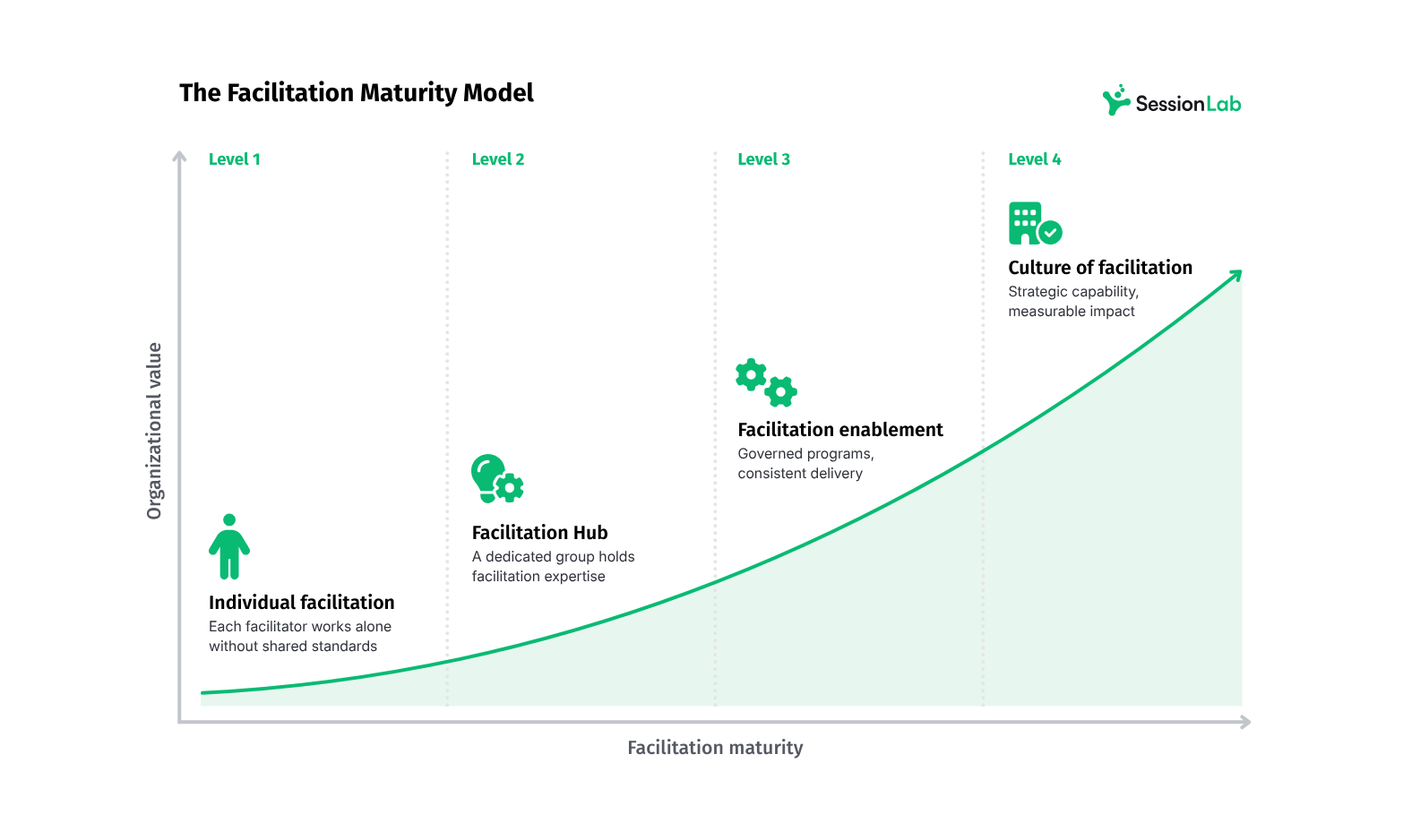
There’s also a broader organizational argument for building an internal CoP. Our research into how facilitation scales inside organizations led us to develop a Facilitation Maturity Model: a four-level framework that maps how organizations progress from isolated individual practice toward a genuine culture of facilitation.
Most organizations start at Level 1 (Individual Facilitation), where skilled facilitators exist but work independently, knowledge stays siloed, and quality depends on whoever happens to be in the room.
The move to Level 2 (Facilitation Hub) is where things start to shift: a core group of facilitators begins to share practices, build common standards, and grow collective capability. A community of practice is the structure that makes that transition possible. Without it, organizations tend to stay stuck at Level 1 indefinitely, even when the individual talent is there.
Check out our guide to scaling facilitation for a fuller picture of how this fits into the facilitation maturity journey.
Finding (or becoming) the facilitation champion
Before the community can exist, someone has to start it. That person is the facilitation champion: the one who holds the energy, organizes the meetings, and keeps the group moving forward.
This might be you. If you’re reading an article about building an internal facilitation community of practice, there’s a reasonable chance you’re already playing this role informally.
Arwen Bailey, Knowledge Sharing Advisor at the Alliance of Bioversity International and CIAT, found herself in this role when she realized that demand for facilitation services was greater than she could handle. The demand spread organically, as colleagues experienced good facilitation and wanted more of it. That organic pull, she reflects, is often more powerful than any formal mandate. With strong senior leadership support, she organized for local trainings in Asia, Africa and Latin America: about 20 facilitators in each region.
When I was doing this alone, there was much more demand for facilitation services than I could handle. When my Knowledge Sharing team expanded to three, we decided to dedicate 15% of our time to facilitating. In addition, we now have 60 trained facilitators in the organization: even if they only had capacity for, say, a workshop a year, that’s 60 workshop opportunities!
Arwen Bailey, Knowledge Sharing Advisor at the Alliance of Bioversity International and CIAT
A facilitation champion doesn’t need to be the most experienced facilitator in the room. They do need to care about growing facilitation capability inside the organization, and they need enough credibility and access to bring people together.
Getting started: from zero to first meeting
The biggest mistake people make when launching a facilitation CoP is overcomplicating it. They plan a learning program before they have a community. They worry about curriculum before they’ve built trust. This likely comes from a fear of not having enough value or content to provide to the people you are gathering. But actually, the value is in creating the container itself and getting those people in the same room. Start smaller than you think you need to, and trust that your group will bring the content themselves.
Make the initial ask easy. The cost of joining a community should feel low at first. You’re not asking people to sign up for a twelve-month program. You’re asking them to come to a conversation. A short email or a quick Slack message (“I’m pulling together a small group of people who are interested in facilitation. Would you be up for a 60-minute conversation?”) is often enough.
Get endorsement from above. This doesn’t need to be a formal sponsorship. But having a senior leader who knows the group exists, and who signals that participating is worthwhile, makes a real difference. People are more likely to show up, and to keep showing up, when they feel the organization supports it.
Run a first session that’s all about sharing, not teaching. The agenda for your first meeting can be simple: what are you each working on? What’s going well? What’s hard right now? What would help you move forward? You’re not there to present the answer. You’re there to find out what the group needs and to start building trust.
To make that first session even easier to set up, we’ve put together a ready-to-use session template for your CoP launch: a 75-minute agenda covering a welcome and framing, a check-in round, a World Café-style experience share, a sense-making exercise to identify focus areas, and a simple close.
It’s designed to be lightweight and participatory from the start, so the group shapes the community together rather than receiving it top-down.

As author and consultant Emily Webber has written in her work on building communities of practice: creating a support network and beginning to build trust is already going to provide outsized value to the organization, even before any formal learning begins.
Your CoP launch checklist
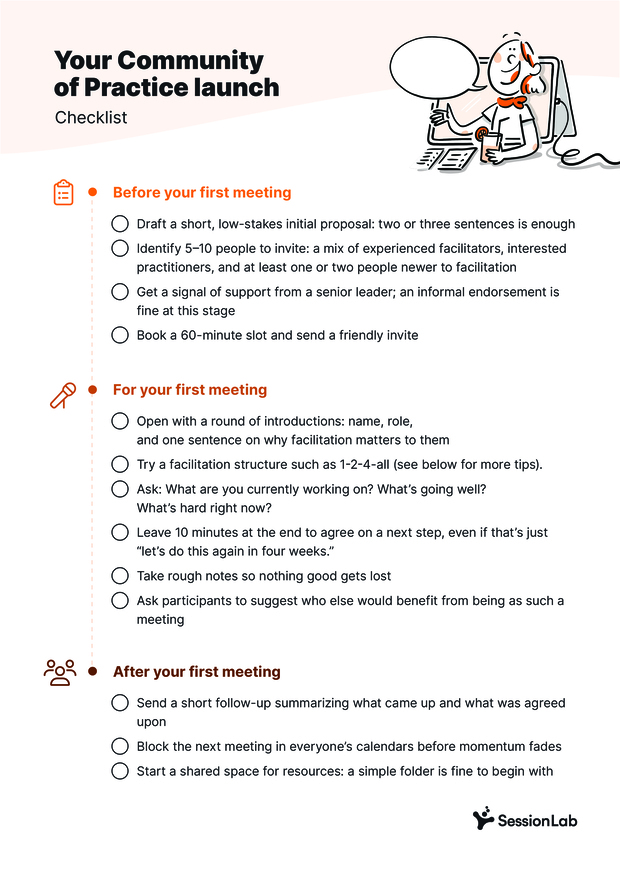
If you’re ready to take the first step, you might appreciate some tips on how to start. The checklist below breaks the process down into three stages: what to do before your first meeting, how to run it, and what to do in the days after to keep the momentum going.
Building trust and cadence over time
After a first session that works, the challenge is keeping the momentum going. Communities don’t sustain themselves automatically.
Set a regular rhythm. Monthly meetings are a sensible starting cadence for most groups. Regular enough to build continuity, not so frequent that attendance becomes a burden. The key is consistency: same time, same rough structure, enough predictability that people can plan around it.
In the facilitation CoP set up by Arwen Bailey and her team at the Alliance of Bioversity International and CIAT, participants are invited to monthly regional calls (for Asia, Africa, and Latin America) and an occasional global one, each hosted by a different community member.”They are convened by different people with different styles, so we all get to learn from one another.” The rotating host model distributes ownership so the community doesn’t depend on one person, and exposes everyone to different facilitation approaches.
Start with sharing, move toward defining. In the early phase, the goal is connection. What’s happening in people’s work? What methods are they finding useful? What challenges keep coming up? Over time, as trust builds, the group can start to move toward shared purpose: What does facilitation mean here, in this organization? What standards do we want to uphold? What should every facilitator on our team know?
Name the resistance to standardization. This is worth doing openly, in the group. When you start talking about shared standards and common processes, you’ll often hear two concerns: that standardization will flatten the creative and emergent quality of facilitation, and that it will force individual facilitators to erase their own voice and judgment.
Both concerns are legitimate, and they deserve a real response, not a dismissal. The best standards in facilitation communities are built with the facilitators, not handed down to them. They capture what already works, and they leave room for adaptation.
The insights that come out of your CoP over time (what methods land, what doesn’t work for this particular organization, what participants consistently need) are some of the most valuable inputs you’ll have for shaping your facilitation practice. Don’t let those conversations disappear after the meeting ends.
Over the last 12 months, have you or your organization invested in developing your facilitation skills? What plans do you have for the year ahead? Who are you actively learning from? We personally learn from teaching others, so who are you supporting and developing?
If you don’t have robust answers to these, it’s time to take action!
Zoë Lord – Deputy Director of NHS Horizons
What happens in a facilitation community of practice?
Beyond the meetings themselves, the richest learning in a facilitation community of practice happens through the specific things you do together:
Share session designs before delivery
Opening your agenda to the group before you run it is one of the simplest and highest-leverage things a facilitation CoP can do. A fresh set of eyes will catch timing problems, spot gaps in the flow, and flag assumptions you’ve stopped noticing. It also builds a shared vocabulary over time: the more agendas people see, the more they develop a common sense of what good design looks like in your organization.
To make it work in practice, keep the bar low. You don’t need a polished document. A draft agenda and a couple of sentences of context (who’s the group, what’s the goal, what are you worried about) is enough. Give reviewers a simple frame: What’s missing? Where would you lose the room? What would you change? A 15-minute async review or a short slot in your CoP meeting is all it takes. Over time, peer design review becomes one of the most reliable quality checks your team has.

Shadow and observe each other
Watching a colleague facilitate and debriefing together afterward is one of the fastest ways to grow, but it works best when it’s structured rather than left to chance. Agree in advance what the observer will pay attention to: energy in the room, use of silence, how transitions land, how the facilitator handles an unexpected tangent. This focuses the observation and makes the debrief more useful.
During the session, the observer takes notes but stays out of the flow entirely. Afterward, give the debrief at least 20 minutes, and start with the facilitator’s own reflection before the observer shares theirs. This keeps it from becoming a one-way critique and often surfaces the most honest observations. If the idea feels exposing at first, start with a low-stakes internal meeting rather than a high-profile workshop, and frame it explicitly as peer learning rather than evaluation.
Give and receive structured feedback
Informal feedback after a session (“that went well!”) is better than nothing, but it doesn’t build skill. What does build skill is a consistent, shared protocol that makes observations specific and actionable. Something everyone in your CoP uses, so feedback doesn’t depend on who happens to be in the room or how comfortable they are with candor.
A simple structure is enough: What worked, and why? What would you try differently? What’s one thing to carry forward? You can run this as a written reflection, a paired conversation, or a short group debrief depending on the context. The key is doing it consistently and treating it as a genuine learning practice rather than a formality. Over time, a CoP that gives feedback well also becomes better at receiving it, which is its own important facilitation skill.
Learn together
Enroll in courses or join webinars as a group, then debrief together. Reading the same book, attending the same conference session, or working through the same online course and discussing it as a group multiplies the learning significantly. Don’t know where to start? Here is a handy list of facilitation books and of recommended courses.
Build a shared resource base
When someone designs a session that lands well, add it to the team library. When a facilitator guide gets refined after delivery, update it and share the new version. SessionLab’s Team Library is designed to make this easy, with a shared space where methods and agendas can be tagged, organized, and found by anyone on the team. Over time, this becomes the institutional knowledge of the group.

5 Activities to run in your facilitation community of practice
A facilitation community of practice is, in part, a chance to practice what you preach. The activities you choose for your CoP meetings send a signal about what facilitation looks like in your organization. Here are some methods worth keeping in your back pocket.
Start meetings with IDOARRT. This simple structure sets out the Intention, Desired Outcome, Agenda, Rules, Roles, and Time for any meeting: at the start, together, with the whole group.
It’s a quick way to create shared clarity before the work begins, and it models good facilitation practice every time you use it. Running your CoP meetings with IDOARRT is also a gentle way to introduce newer facilitators to the technique without making a big deal of it.
Use Appreciative Inquiry: Root Causes of Success to open early sessions. The temptation in any new community is to start with problems. Appreciative Inquiry flips this. Participants pair up and interview each other about a time when facilitation really worked: what happened, what made it possible, what conditions were in place. Stories surface. Patterns emerge. The group starts to understand what it’s already doing well, which is a much more energizing foundation for building shared standards than a list of complaints.
Try What I Need From You (WINFY) once the group has some trust built. This Liberating Structure is designed for groups with interdependent roles, which a facilitation team absolutely is. Each person or subgroup articulates clearly what they need from others to do their best work, and others respond with yes, no, or a counter-proposal.
It’s a structured way to surface the unspoken expectations and dependencies that often slow teams down. For a facilitation CoP, it can be a powerful moment to realize that trainers need more lead time from L&D managers, or that newer facilitators need observation opportunities that nobody has formally offered.
Troika Consulting is a Liberating Structure that gives facilitators a structured way to get peer coaching on a real challenge, quickly. In groups of three, one person shares a current issue they’re facing (something live in their work, not a hypothetical) while the other two listen without interrupting. The person with the issue then turns their back, and the two “consultants” discuss what they heard and offer their thinking. The person turns back around, listens, and takes what’s useful.
The whole cycle takes about fifteen minutes. For a facilitation CoP, it’s a particularly good fit: facilitators tend to be skilled at holding space for others but less practiced at asking for help themselves. Troika creates a container that makes it structurally easy to do both.
Theory U Coaching Circles and Case Clinics bring a deeper, more reflective quality to peer learning. Based on Otto Scharmer’s Theory U framework, the practice gathers a small group (typically five to seven people) around one person’s challenge. The process moves through four phases: the person shares their situation; the group asks clarifying questions without offering solutions; the group then reflects back on what they noticed, including what remained unspoken or underneath the surface; and finally, the person reflects on what landed.
The emphasis is on presence and listening, not problem-solving: the goal is to help the person access their own clarity rather than receive the group’s advice. In a facilitation CoP, Coaching Circles are well-suited to the more complex, relational challenges that don’t have clean answers: navigating a difficult stakeholder, feeling stuck in a recurring dynamic, or questioning your own practice at a deeper level.

At SessionLab, we practice what we preach. We’re a small team, spread across time zones, with varying levels of facilitation training and experience. What we’ve found is that you don’t need a formal program to build a facilitation culture.
We have a Slack channel for facilitation practice where people drop tips, questions, and the occasional method they’ve just tried for the first time. Another channel is for facilitation learning: write-ups, reflections, and highlights from conferences, webinars, and events that team members attend. At our all-hands meetings, we take turns leading check-in activities, which means everyone gets a chance to facilitate something small in a low-stakes setting.
At our in-person team retreats, the more experienced facilitators among us have run training sessions for the rest of the team. Over time, these practices have built a shared vocabulary, a collective curiosity about the craft, and a team that knows how to run a good meeting.
As your community matures, it will generate materials: session templates, facilitator guides, tested activities, process documents, feedback results. The challenge is making sure those resources are findable and actually used, rather than living in someone’s personal drive or getting buried in a Slack thread.
This is where structure starts to matter, and where the right tooling pays off.
SessionLab’s Team Library is built for exactly this situation. You can build a shared library of your best activities and session templates, tagged and organized so that any facilitator on your team can find the right method for any session. When a new facilitator joins, they’re not starting from scratch: they have access to the collective knowledge of the group.
Alongside the library, Pages is useful for the documentation layer: facilitation guides, onboarding resources for new members, a brief for new joiners explaining the community’s purpose and ways of working.
If you’re scaling training programs across the organization, building out thorough facilitator guides for each program means your best work becomes reproducible, not dependent on memory or tribal knowledge.

A good example of what a mature facilitation community can produce is the NHS Institute for Innovation and Improvement’s Facilitator’s Toolkit: a practical, 100-page resource covering everything from session openers and icebreakers to managing group dynamics and closing techniques, built from the collective experience of their internal facilitators. It’s the kind of artifact that only becomes possible once a community has been sharing, refining, and documenting its practice over time.
What comes next: growing your CoP
A community of practice evolves. What works in the first six months isn’t the same as what serves the group at year two. Here’s a rough sense of how that progression tends to look.
Early stage: small group, informal, focused on connection and sharing experiences. Trust-building is the main work. Showing up is the main ask.
Middle stage: the group has found its rhythm. Some shared standards or practices are starting to emerge. People are beginning to identify as part of something. There may be natural leaders stepping forward beyond the founding champion.
Later stage: a more formalized structure, with defined core members, clear ways of bringing new people in, and an organized body of knowledge. The community is actively contributing to what facilitation looks like in the organization: influencing training programs, onboarding materials, how workshops get commissioned and evaluated.
At this point, your CoP is doing something powerful: it’s becoming a pipeline. The facilitators in the group are spreading capability to their teams, advocating for facilitation in spaces where decisions get made, and growing the next round of champions.
This is also where your facilitation community connects directly to impact. A CoP that tracks what works, shares feedback across sessions, and contributes to shared standards generates the kind of evidence that makes facilitation visible to leadership. If you want to go deeper on this, our guide to high-impact facilitation covers how to design for outcomes and demonstrate results in ways that resonate upward.
If you want to go deeper on CoP maturity, the Tacit Communities of Practice Organisational Maturity Model is a useful framework. It maps five levels of organizational readiness across six dimensions (structure, culture, collaboration, support, technology, and impact) and is useful for assessing not just how a single community is progressing, but whether your organization has the right conditions in place to support communities of practice at scale.

Beyond your organization: freelancers, local meetups, and outside inspiration
Communities of practice for facilitators didn’t start in corporate L&D departments. Long before organizations began formalizing internal hubs, freelance and independent facilitators were gathering in cities and online to do exactly what a CoP does: share experiences, practice together, and keep each other sharp.
If you’re an independent facilitator without an organization to build inside, this is your version of the CoP. Local facilitation meetups, online practice groups, and professional associations like the International Association of Facilitators (which runs chapters and events in dozens of countries) offer the same foundation: a community of people who care about the craft, meeting regularly to develop it together.
The Fit for Facilitation community is another active online space worth knowing about, with practitioners sharing resources and supporting one another’s development. And if you want somewhere to connect with other SessionLab users, swap methods, and talk facilitation with a global network of practitioners, the SessionLab Community is open to join. It’s a loose network rather than a formal CoP, but the spirit is the same.
Beyond these, many more communities exist: local facilitation networks, meetup groups, and peer learning circles that don’t always have a visible online presence but are well worth finding. If you’re curious what exists in your area or your corner of the profession, ask around: facilitators tend to be generous with this kind of information.
If you’re building an internal CoP, you might want to join an external community as well, and borrow their practices. Freelancers and independent practitioners who gather in these communities tend to bring a breadth of perspective that internal groups can lack: exposure to different industries, methodologies, and approaches that organizations rarely encounter on their own.
Opening your internal CoP to occasional outside voices is a simple way to inject that kind of fresh thinking. Invite a local facilitator to join a session as a guest. Attend an IAF event together as a group and debrief what you heard. Bring in a freelancer to co-facilitate one of your CoP sessions and observe how they work.
The internal and external don’t have to be separate worlds. Some of the most effective facilitation communities deliberately operate at both levels: building shared standards inside the organization while staying connected to the wider professional conversation happening outside it.

How SessionLab can support your facilitation community
Building a community of practice is fundamentally about people, but the right infrastructure makes it easier for those people to do their best work together. As your CoP grows, having a single place to design sessions, store shared resources, and document your practice removes a lot of the friction that causes communities to stall.
Here’s how SessionLab’s features map to the different stages of your community’s growth.
A shared library your whole team can build and use. As your community generates its best methods, templates, and activities, SessionLab’s Team Library gives you a place to collect and organize them.
Facilitators across your organization can browse, adapt, and reuse what the group has created, so the collective knowledge of your CoP becomes accessible to everyone, not just the people who were in the room when it was developed. Tag methods by theme, session type, or skill level to make finding the right activity fast.
Facilitator guides that make your best work reproducible. One of the most valuable things a CoP produces over time is a shared understanding of what good facilitation looks like in your organization.
Facilitator guides are how you capture that understanding in a form that any trained facilitator can pick up and run with, consistently, at scale, without losing quality. SessionLab is built to make creating and maintaining those guides straightforward.
A foundation for demonstrating impact. A community of practice that tracks what’s working, shares session feedback, and builds shared standards is also generating the evidence that makes facilitation visible to leadership. SessionLab Forms let you attach feedback surveys directly to sessions, so impact data flows naturally into your practice rather than becoming a separate reporting task.
If you’re ready to give your facilitation community a proper home, try SessionLab free and see how it fits your team’s workflow.
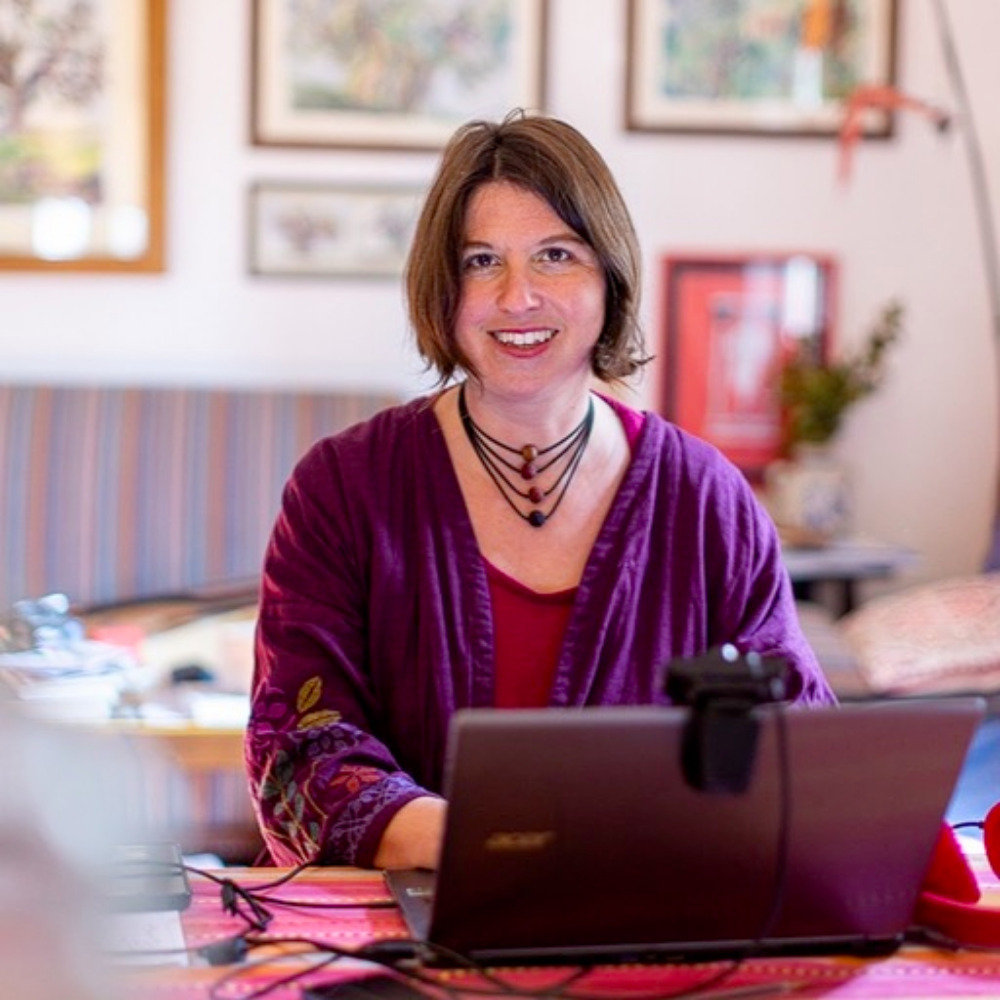
Deborah Rim Moiso is an Endorsed Facilitator with the IAF – International Association of Facilitators and former co-chair of the Italian IAF Chapter.
She is the author of a manual and deck of cards on facilitation available in Italian (Facilitiamoci!). Deborah has been working with groups since 2009 in the fields of innovation in education, citizen participation, and environmental conflicts.


Leave a Comment