System Mapping Workshop
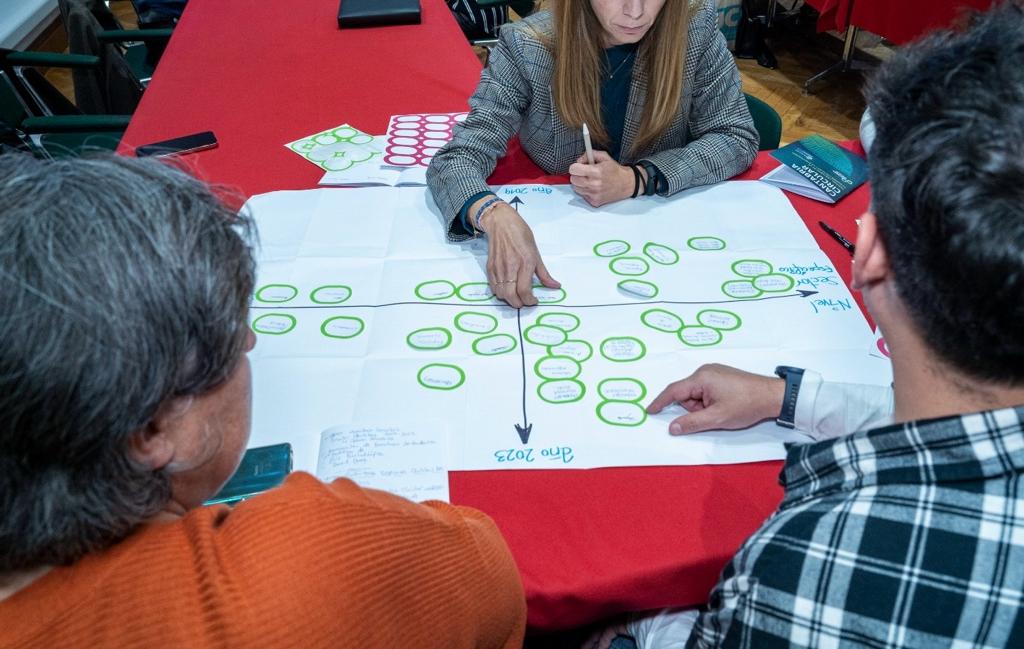
A 3-hour workshop designed to help your organization see the big picture. Literally. Gather team members and stakeholders together to visualize the various elements of a system and draw connections. With a map of the territory finally at hand, discuss findings, gain insights, and potentially even define points of intervention for innovation and change.
Some applications of system mapping workshops are:
Identifying points of intervention in a large organisation.
Facilitating circular economy projects.
Landscape and resource management and policy-making.
Preparing for multi-stakeholder participatory processes.
Helping NGOs and volunteer organizations select impactful projects.
..and more!
Objectives
- Gain clarity in complex scenarios;
- Build shared understanding;
- Zoom out to see the big picture;
- Co-create a visual representation of your system;
- Identify potential starting points for impactful interventions.
Materials
Attachments
- 124All cover.PNG
- 124All.PNG
- noun_66246_B36AE2.png
Instructions
When should this systems mapping workshop be delivered?
Systems mapping is a “big picture” kind of workshop. If the issues you are facing are relatively simple, there is no need to zoom out so far.
If you are confused about next steps, or mixed up about what is going on in your organization, territory or industrial landscape, this is an excellent way to get clarity and build a shared understanding of the present situation and, potentially, of where to direct efforts next.
While you can actually build a systems map on your own (and that might help strategic thinking), real effectiveness comes with having different perspecitves in the room.
Invite people from different teams, departments, representatives of stakeholder groups, experts who look at an issue from various fields (academia, industry, etc.) to get fresh input and views.
Some applications of system mapping workshops are:
- Identifying points of intervention in a large organisation. Organization charts are all well and good but that’s not necessarily how information really flows within your structure.
- Facilitating circular economy projects. System mapping is great for visualizing and sharing points of view about where loops can be closed and resources circulated.
- Landscape and resource management and policy making. Mapping what is going in the local territory is an essential first step in any larger participatory process.
A small-scale system mapping workshop I ran for a local environmental NGO in 2018 helped the group acknowledge what was already happening in their area, avoid replicating efforts, find allies and decide what projects to focus on.
At this link you can find a slide deck explaining how the University of Edinburgh used this approach to map a whole production system, using causal loops and identifying points for intervention.
If you know how to lead a group through interactive activities and discussions you know what you need to do to lead systems mapping workshops. On the other hand, to authoritatively explain the rationale behind it, answer questions and run this workshop smoothly it’s important that the facilitator gain a general understanding of systems thinking and/or systems innovation practices.
Two great places to start are the Participatory Systems Mapping course offered by Acumen Academy and the System Mapping Academy’s System Mapping Training.
Systems maps are often a part of organizational development interventions that imply many more steps. To get an idea of what those could be, check out our blog article on OD interventions.
Please note: Mapping a system is only one of many tools in frameworks that include systems thinking, systems innovation and complexity sciences. There is much more to those frameworks than the work of drawing out the elements of a system and their connections, as is illustrated here.
System mapping could be your, and your participants’ first encounter with these powerful toolsets, and is useful also as a standalone format.
For a deeper dive into System Mapping check out this in-depth publication by Pete Barbrook-Johnson and Alexandra S. Penn.
Absolutely! Although you might miss out on some of the social cues and lively interactions of an in-person workshop, mapping a system online is guaranteed to lead to more manageable outputs.
Instead of a big canvas of stickynotes, drawings and lines, you’ll end up with a shareable map on a virtual whiteboard. If you are planning to run system mapping sessions virtually or in hybrid mode, it’s well worth familiarizing with online system mapping tools such as Kumu.io.
Author
James Smart is Head of Content at SessionLab. He’s facilitated workshops and designed elearning experiences for places including the University of East Anglia and the National Centre for Writing.
More about author