Hybrid Community Event

103

This 1-day community event is designed to enable participants in-person and online to reflect back on the past year and design next steps for the future. This design was created for a professional organization of coaches that meets yearly (for the first time, this was a hybrid gathering). The goals of this template include: - networking among members; - retrospective and learning from the past year; - co-creating ideas and projects for the future. The template showcases how to use SessionLab's breakout function to display parallel timelines for the different groups in hybrid events.

Duration: 450m +
Participants: Any
Facilitators: 1 - 2
Difficulty:  Medium
View Template
Use Template

Objectives

  • Facilitate engagement of remote and in-person attendees.
  • Experiment with hybrid participation in a low-tech, low-key environment.
  • Creating connections and networking among participants.
  • Inspiring and re-energizing the community.
  • Reflecting on the past year.
  • Ideating and discussing on topics of interest to the group.
  • Creating a list of recommendations for the steering committee for the next year.

Materials

    Attachments

    • 06a_visual regels World Cafe.png
    • 11. World Cafe (1).jpg
    • 124All cover.PNG
    • 124All.PNG
    • DSC_0001-02.jpeg
    • feedback.jpg
    • IMG-20211216-WA0028.jpg
    • Impromptu Networking cover.PNG
    • phone.jpg
    • touch-blue-cover.jpg
    • welcome_belinda_fewings_unsplash.jpg

    Instructions

    When should this session be delivered?


    This session template is based on an event held in Valencia in December 2021 for the ClimateKIC’s Network of Climate Coaches (NoCC). The NoCC is a community of practice focused on enabling sharing of knowledge and opportunities for professional growth among coaches, trainers and facilitators associated with the European Knowledge and Innovation Community on Climate.

    This gathering’s aims are typical of an end-of-year community event: to inspire and engage members, facilitate networking, and create an action plan for the coming year. More specifically, in this case, the desired output was a list of recommendations for the steering committee to work on.


    How should this session be organized?


    This session is based on a community gathering which is held once a year (in-person until 2020, then online for two years). The December 2021 event was the group’s first experiment with hybrid participation.

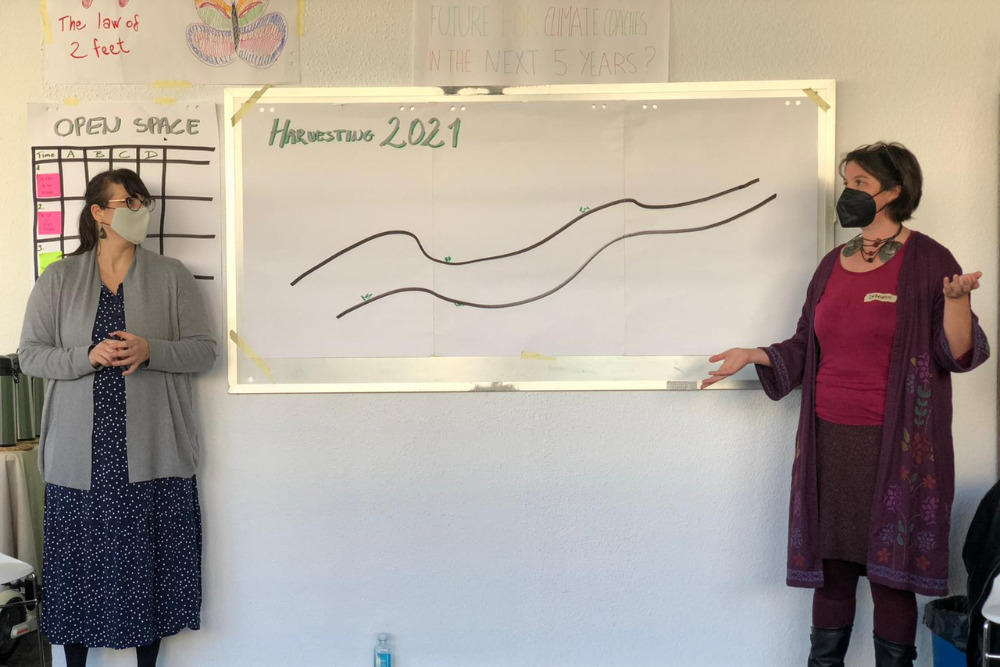
    About 30 people joined in person in Valencia, and about 20 people connected remotely, via Zoom, from all over Europe and the world. The budget was limited, and so was time for preparation.

    Three decisions were taken as to how to approach the challenge of organizing a hybrid event for the first time:

    • We would work in a team of three: one facilitator online taking care of virtual participants, and two in the room.
    • One of the in-person facilitators held the role of “bridge-builder”, tasked with paying particular attention to the creation of connections between what were in effect two parallel events;
    • We would keep moments in which the group actually worked with both cohorts together limited to plenary sessions and “hybrid checkpoints”, for the sake of simplicity.

    The event was a successful mix of learning, fun, and connection. This is a great session template if you wish to

    • Experiment with hybrid in a safe, low-tech way;
    • Enable networking, sharing, and a community feeling.


    Facilitator's tips


    In hybrid events like this one, there are likely to be times in which the online and in-person participants join different activities. It can therefore be tricky to show in an agenda how the different timelines flow together. As we discovered when preparing this design, remote and in-person sessions have different time requirements!

    The “breakout sessions” feature in the SessionLab planner is a helpful tool to solve this issue (find more information on this feature on this support center page). The feature makes it possible to create two or more tracks running in parallel. Using this function it’s therefore easy to see, at a glance, when the different cohorts are running on different schedules, and when they can regroup.

    Here are four things we learned when scheduling parallel activities for remote and in-person groups:

    • Use activities adequate to the situation (remote or in-person) but with the same general intention or purpose (e.g. networking, ideating…);
    • Online, small-group breakout activities are shorter than in-person;
    • The extra time saved should go to having more breaks for the online attendees!
    • Use shared online documents to collect and share insights.

    Who can facilitate it?


    To facilitate a successful hybrid event for a community gathering you’ll need a facilitation team of at least two people: one to work with online attendees and one in the room. Make sure you have an opportunity to connect and align with your co-facilitator before the start!

    The activities themselves are not particularly challenging. The afternoon is mainly structured as a World Café. Focus questions for the breakouts and tables should be chosen by the facilitation team based on the group’s needs and on the morning’s conversation (to know more about this methodology you can go to the World Café community’s website). Another option is to use Open Space Technology, particularly if you want to give participants more freedom on what to bring into the discussion (for more on OST, see this template!).

    If you have the opportunity to create a larger team, it can certainly be helpful to have an extra person taking care of the “bridge” between online and in-person (shout out to my co-host Szilvia Zsargo) and a tech host to support the virtual part (although the brilliant Rowan Simonsen managed to handle it all himself!).

    Richer, more complex hybrid environments enabling sustained collaboration between “roomies” and “Zoomies”, are likely to be a part of the facilitator’s toolkit in the near future. That said, this template is a great way to start exploring the possibilities of hybrid event facilitation: it worked for us and we’d love to hear back whether it works for you!

    Author

    James Smart is Head of Content at SessionLab. He’s facilitated workshops and designed elearning experiences for places including the University of East Anglia and the National Centre for Writing.

    More about author

    0 Comments

    Please Log in or Sign up for a FREE SessionLab account to continue.