Scenario Slider
Scenario Slider
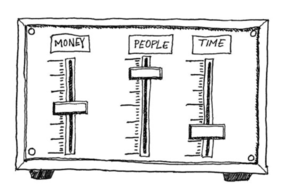
After coming up with great ideas, the next challenge is figuring out the best way to make them happen. This exercise is one of many types of “scenario” games which can be used to test ideas and try out different approaches to bring them to life.
Duration: 15m - 30m
Participants: 5 - 15
Difficulty: Low
Goal
To get groups to model a business approach based on several extreme scenarios, using two to three variables.
Materials
Instructions
Preparation
- In advance, select two or three variables which would impact how your idea would be implemented. If it’s a project, it could be “money, people and time”.
- It’s helpful to set some context for your variables. Money could range from $10k to unlimited funds, for example, while time might be “done in 3 months” to “as much time as you need”.
- Set two or three different scenarios, adjusting the “sliders” in your three variables to a couple of possible extremes. Don’t be worried if this is actually the case in reality; playing with the extremes helps to find unexpected answers. One scenario might be “unlimited funds, all the people you need, must be done in three months.”
Flow
- Working with a number of groups in parallel, assign one scenario to each group. Ask the groups to come up with an approach based on that scenario. Instruct the groups to take the scenario as a given – don’t say it’s impossible in three months; tell us how you’d do it.
- Allow the groups to all share their work with the others, outlining their approach as well as explaining the tradeoffs and shortcomings based on the constraints of their scenario.
- Debrief as a large group to identify ideas that people agree should go forward, and which variables and constraints the group believes to be non-negotiable.
Note: Getting the groups to produce something for the report out helps them crystallize their thinking and gives the broader group a something tangible to work with when debriefing. Getting them to draw models or doodles to illustrate their ideas can help get them focused on delivering a product.
Attachments
- Scenario Slider cover.PNG
Background
Source: Gamestorming
Author
Gamestorming is a set of co-creation tools used by innovators around the world.
Think back to the last time you played a game. What was the game? Why did you choose to play? Was it a simple game like tic-tac-toe, or something more complex, like Monopoly, Scrabble or Chess? Or maybe it was a game of basketball? Did you play with friends? With family? Try to recapture the feeling you had as you played the game. How did it feel? Would you like to have more of that feeling at work?
Games come naturally to human beings. Playing a game is a way of exploring the world, a form of structured play, a natural learning activity that’s deeply tied to growth. Games can be fun and entertaining, but games can have practical benefits too.
These games are designed to help you get more innovative, creative results in your work. We’ll show you not only how to play them but how to design them so they fit your own specific work goals.
More about author1 Ratings
This method has been rated 1 time(s), with an average rating of 4.0.