Make A World
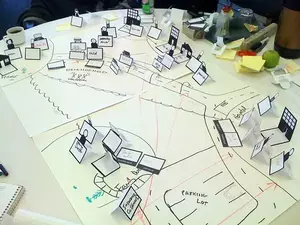
The Make a World game appeals to visual, auditory, and kinesthetic learners because of its layers of interaction. It’s useful (and downright fun) because it lets players imagine the future and take action to create a first version of it. All successful ventures start with a vision and some small, initial effort toward crystallization. Alexander Graham Bell’s vision for the telephone started as highly rudimentary sketches.
Goal
The purpose of Make a World is to create a three-dimensional model of a desired future state.
Materials
Instructions
How to Play
- Before the meeting, determine a meeting topic. It can be any topic that would benefit from the group advancing it to a desired future state (e.g., “Our new branch location in Austin” or “Our future marketing strategy”).
- Tell the players the meeting topic and give them access to flip-chart paper, markers,sticky notes, pipe cleaners, modeling clay, magazines, index cards, tape—any art supplies available to help them “make a world.”
- Break the players into groups of three or four and give them 10–15 minutes to agree on a shared vision to make into a three-dimensional world. Explain that the world can include people, scenes, buildings, products and features, and anything they deem necessary to show an idealized version of the topic.
- Give the players 20–30 minutes to brainstorm the attributes of the world and physically create it using art supplies.
- When the time is up, give the players five minutes to create a slogan or tag line to summarize their world.
- Have each group showcase their “Eden” and give the others insight into what it offers. Make note of any recurring themes or parallel features in these “fantasy lands.”
Strategy
Any desired state can be visualized. The game isn’t confined to creating 3D models of widgets or parks or products or real estate. The “world” that players create could be anew landscape for a video game, a happier and more aligned team, a globally distributed supply chain, and so forth. The challenge for each group will be in the process of ideating and creating without shutting out possibilities. Encourage them to be expansive in their thinking. In this game, players are limited only by their imaginations and their art supplies.
Attachments
- Make-a-world-cover.webp
Background
The title of this game was inspired by Ed Emberley’s book, Make a World.