Fishbowl
Fishbowl
The Fishbowl game is an effective way to activate attention—to prime our natural listening and observing skills so that a more substantive conversation can take place.
Duration: 45m - 60m
Participants: 10 - 20
Difficulty: Low

Goal
To practice active listening and engage in meaningful conversations
Materials
Instructions
Preparation
- Before the meeting, think of a topic that could be served by a group discussion and write down questions associated with it.
- Find a room with a good amount of open space and clear out anything other than chairs.
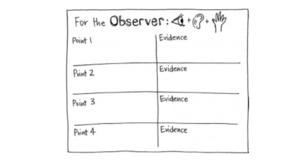
- Create a handout (see 'Attachments')
- Arrange the chairs in two concentric circles in the room, (see 'Attachments'). The inner circle seats the players engaged in conversation; the outer circle seats the players acting as observers.
Flow
- Introduce the game and assign “observer” or “player” status to each person. Give everyone a pen and a handout (but mention that the handout is used only in the observer role). Ask the participants to sit in the circle relative to their assigned role.
- Announce the topic of the game and ask the players to take 15 minutes to have a discussion around it. Use the questions you generated before the meeting to start the conversation and keep it moving. Make sure the players know that their responsibility is simply to converse in the circle. Make sure the observers know that their role is to pay close attention and to write on the handouts all discussion points and evidence that come out of the conversation.
- When 15 minutes are up, ask the group to switch seats and switch roles. Then start another 15-minute discussion on the same topic or a different one.
- After both conversations have completed, ask for volunteers to share the information they gathered and ask them to describe their experiences on the inner versus outer circle.
Note: Talk to the group about their experience of being silent and paying attention. What was difficult about it? What was easy? How did it affect their perception of the topic and the other players? Use the Fishbowl exercise as a segue to a heightened give-and-take between stakeholders.
Attachments
- Fishbowl cover.PNG
- Fishbowl chairs arrangement.PNG
Background
The Fishbowl game is based on ideas from the Facilitator’s Guide to Participatory Decision-Making, by Sam Kaner et al.
Source: Gamestorming
Author
Gamestorming is a set of co-creation tools used by innovators around the world.
Think back to the last time you played a game. What was the game? Why did you choose to play? Was it a simple game like tic-tac-toe, or something more complex, like Monopoly, Scrabble or Chess? Or maybe it was a game of basketball? Did you play with friends? With family? Try to recapture the feeling you had as you played the game. How did it feel? Would you like to have more of that feeling at work?
Games come naturally to human beings. Playing a game is a way of exploring the world, a form of structured play, a natural learning activity that’s deeply tied to growth. Games can be fun and entertaining, but games can have practical benefits too.
These games are designed to help you get more innovative, creative results in your work. We’ll show you not only how to play them but how to design them so they fit your own specific work goals.
More about author2 Ratings
This method has been rated 2 time(s), with an average rating of 4.5.