Build a Checklist
Build a Checklist
Because a checklist is a focusing object, it demands that the team discuss the order and importance of certain tasks. Team members are likely to have different perspectives on these things, and the checklist is a means to bring these issues to the surface and work with them.
Duration: 60m - 90m
Participants: 3 - 6
Difficulty: Low
Goal
To build a checklist around a problem or task
Materials
Instructions
Flow
- To begin, introduce to the group the topic at hand: “You will be creating a checklist for doing [fill in the blank].” It may be useful to prime the group into thinking about a particular situation or duration of time, as in “Getting from A to B” or “Dealing with an Angry Customer.”
- Have the group brainstorm tasks to put on the checklist using sticky notes. Guide the group to create items that are concrete and measurable, like a switch that is turned on or off. For example, “assess arrival readiness” is not as useful as “deploy landing gear.”
- Once the group has generated a pool of ideas, they may use Post-Up and Affinity mapping to remove duplicate tasks. In discussing what has been added to the list, two things may be done:
- Have the group order the tasks into a procedure. Use sticky notes so that the individual tasks can be moved. Given a space with a beginning and an end, the group can discuss and debate the ordering while creating the list in real time.
- Have the group force-rank the tasks. In this case, the group must decide the order of importance of the tasks. By doing this, the group may be able to agree to cut items from the bottom of the list, making their checklist shorter and more direct.
Background
The Build the Checklist game is credited to James Macanufo.
Source: Gamestorming
Author
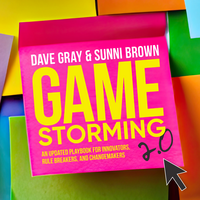
Gamestorming is a set of co-creation tools used by innovators around the world.
Think back to the last time you played a game. What was the game? Why did you choose to play? Was it a simple game like tic-tac-toe, or something more complex, like Monopoly, Scrabble or Chess? Or maybe it was a game of basketball? Did you play with friends? With family? Try to recapture the feeling you had as you played the game. How did it feel? Would you like to have more of that feeling at work?
Games come naturally to human beings. Playing a game is a way of exploring the world, a form of structured play, a natural learning activity that’s deeply tied to growth. Games can be fun and entertaining, but games can have practical benefits too.
These games are designed to help you get more innovative, creative results in your work. We’ll show you not only how to play them but how to design them so they fit your own specific work goals.
More about author1 Ratings
This method has been rated 1 time(s), with an average rating of 3.0.