How Prasada builds leadership programs at scale using SessionLab

At the training and consultancy company Prasada, leadership development starts from the inside out. Founded in 2009 by Alice Dommert, the practice helps individuals and organizations build the capacity to navigate pressure with greater awareness, resilience and confidence.
Over more than 17 years, Prasada has supported over 25,000 people and worked with more than 250 organizations through leadership programs, corporate wellness work and retreats.
Originally trained as an architect, Alice has always been fascinated by how the environments we create shape the way we live and work. Today, she and partner Jarrod Matteson, a former attorney, design experiences for audiences as different as law firm leadership teams and healthcare organizations.
At first, Alice’s knowledge lived, well, in her head, as is often the case. Programs were planned in Excel, and getting the timing right for programs with similar content but different lengths was, in Alice’s words, a nightmare. Content segments repeated across programs, with no organized library to keep them in.
As Prasada began to scale, Alice and Jarrod needed to keep their experiences consistent, adaptable and ready for a growing array of programs and a growing team of facilitators. To make this possible, they rely on SessionLab, as customers since 2020. Let’s see how.
“More of our design intelligence is visible, reusable, and shareable. Important knowledge is no longer held only in one person’s memory, a slide deck, or scattered notes.”
Connecting inner capacity with professional performance
We are living through a time of unprecedented change. As new technologies reshape work, organizations are seeing what humans uniquely need to bring to the workplace: presence, wisdom and a bigger-picture view.
“We don’t need better time management; we need better energy and nervous system management, and the practices to help build the capacity to lead under pressure.”
Prasada’s programs span leadership development and corporate wellness, including onsite programs, retreats, online virtual programs and on-demand programs. What sets them apart is how that deeper human work is translated into language and tools that make sense at work.
“We don’t simply give people information about leadership or wellbeing. We help them notice what happens under pressure, orient to their principles to respond differently in the moment, and identify a practical behavior they can use at work.”
Whether it’s a leadership workshop for a law firm, a wellness program for a healthcare organization or a retreat for individuals, every program is guided by the Centerline Method, Prasada’s framework: Notice, Orient, Practice, Integrate. Participants notice the patterns pressure creates, orient to their principles so they can respond more intentionally, practice small behaviors, and integrate them into how they lead and work, contributing over time to a healthier culture. The team then hones in on what each client needs: judgment and delegation for a law firm, recovery and attention in healthcare, reflection and connection on a retreat.
“The context changes, but the Prasada Way provides coherence.”
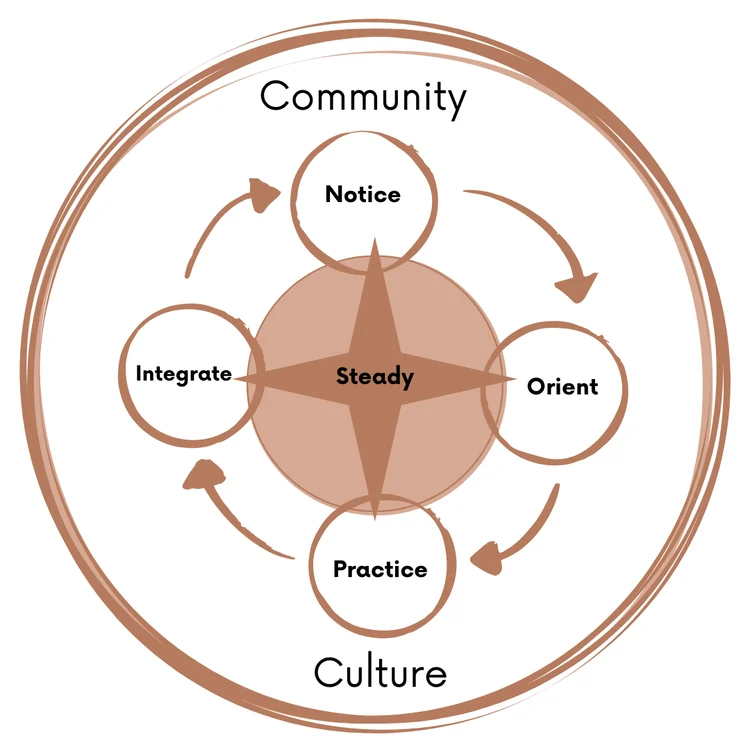
Post-program surveys, client conversations and requests for further work all provide feedback. But the most meaningful sign of success is whether participants can name and use something from the experience in a real moment of pressure. They begin to see challenges as growth ready for harvest when they have the right tools and practice. That enhanced capacity is the real success.
Quality and consistency also depend on preparation, especially with different audiences and different facilitators leading different programs. Slides only tell part of the story.
Our facilitators need more than presentation slides. They need to understand each activity’s purpose, the transitions, the timing, the questions to ask, and the engaged experience we want participants to have.
And that is where SessionLab comes in.
Prasada originally planned its programs in Excel. Getting the timing right for programs with similar content but different lengths was a nightmare, and segments that repeated across programs had no organized home. With SessionLab, the team can adjust timing, assign presenters and draw on a shared library, saving time and keeping content consistent.
SessionLab holds the thinking behind the experience
SessionLab is Prasada’s central design and facilitation workspace. It’s where the team organizes the arc of a program, clarifies outcomes, structures activities, manages timing, documents facilitator instructions, assigns presenters and roles, and lists the materials needed.
“A slide deck shows what participants see, but SessionLab holds the thinking behind the experience and guides the whole process.”
Seeing the whole program in one place also helps Alice check the balance of a design. Is there the right mix of teaching, reflection, conversation, practice, engagement and application? With every block timed and color-coded, gaps and overloaded stretches are easy to spot.
Prasada manages its programs to the minute. SessionLab shows the team where they are, and where they need to be, at every point in a session, so every minute can be honed to its fullest value. That matters most when clients try to fit too much into a session. Sharing the planned agenda shows clients how carefully everything has been thought through.
“They can see how well thought out everything is and know we are really the best at what we do because of this tool.”
Design intelligence that is visible, reusable, and shareable
The biggest change since Prasada started working this way is where its knowledge lives.
“Important knowledge is no longer held only in one person’s memory, a slide deck, or scattered notes.”
With the whole experience in one place, the team can adapt existing work faster, collaborate more easily with other facilitators, and improve programs as they are presented and evolve. They can see what needs to change for a particular client and protect what should stay consistent.
That matters for Prasada’s long-term plans. The goal isn’t only for the founders to deliver excellent programs, but to build a methodology a larger team can teach, deliver and strengthen.
“Documenting the purpose, flow, practices, and facilitation choices behind our programs is essential to doing that well.”
Reusable templates, adapted for every client
Instead of scattered spreadsheets, Prasada now keeps its content segments in an organized library, and its strongest program designs live in SessionLab as reusable plans and templates. With more than 100 unique programs, each adapted anywhere from 3 to 30 times, starting from proven templates is what makes that volume possible. When a new client comes in, the team adapts the language, examples, activities and emphasis to fit, and adjusts timing for programs of different lengths in a few clicks.
The same approach covers everything from online, in-person and virtual presentations lasting 5 minutes to multi-day retreats, as well as scripts for audio and video recordings and team meeting agendas.
“We don’t have to start with a blank page each time, but we also don’t have to deliver a rigid, one-size-fits-all workshop.”
Consistent quality, whoever is facilitating
About 15 facilitators have been involved in Prasada’s programs over the years, and the team often co-creates presentations with collaborators. Every time, the starting point is a Prasada template in SessionLab, and new collaborators are always impressed when they are introduced to it.
As the business grows and more people contribute to delivery, SessionLab gives everyone the same reference point. Facilitators and co-facilitators can review the flow, roles, instructions, materials, timing and intended outcomes before they step into the room. After the program, the team debriefs and improves the plan for next time.
“A co-facilitator can understand not only what happens next, but why it is there and what we are trying to accomplish. That makes preparation and handoffs easier and helps us maintain quality as more people contribute to program delivery.”

Printouts that fit the moment
One feature Alice particularly values is SessionLab’s customizable printouts. Agendas used to be hard to print well on a regular portrait page, coming out either too large or too small. Now Alice can choose the columns she wants to see and set the size and margins for a printer-friendly result.
“I like the new options for printing a session to my customization.”
Different facilitators and settings need different formats. A breathwork retreat calls for printouts that are easy to read at a glance. An online law firm presentation may run on a separate monitor, and a keynote for a large audience may need another format again. Because every version comes from the same plan, when the design changes, nobody is working from an outdated copy.
Growing without losing the personal touch
For other leadership development practices that want to scale, Alice’s advice is to codify what matters without making the work mechanical. Don’t document only the agenda: capture the intention behind each part of the experience. And build templates that are strong enough to provide consistency, but flexible enough to respond to the people in the room.
For Prasada, structure and presence aren’t in tension. A well-documented design frees facilitators from avoidable preparation work, so they can focus on what matters most: the people in front of them.
“Structure does not have to remove the personal touch. Done well, it protects the personal touch by reducing avoidable preparation work and giving facilitators more capacity to be present, responsive, and human with participants.”


Leave a Comment