Who Do

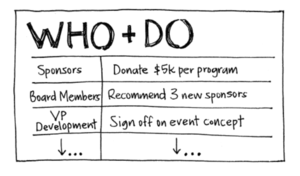
Who do you want to do what? Almost any endeavor of substantial impact requires seeking help from others. Developing a WHO + DO list is a simple way to scope out the undertaking.

Duration: 20m - 45m
Participants: 2 - 10
Difficulty:  Low

Goal

To define who is responsible for what

Materials

    Instructions

    Flow

    1. Start with the vision. Write out or visualize the big goal.

    2. Draw a two-column matrix and write “WHO” on the left and “DO” on the right.

    3. Ask: Who is involved in making this happen? Who is the decision maker? Who has needed resources? Who may be an obstacle? Whose support is needed? These individuals or groups are your list of WHOs.

    4. The DOs are often harder. For each WHO, ask: What do they need to do, or do differently? What actions will build toward the big goal? Sharpen each WHO in the list until you have a desired and measurable action for each.

    5. Given all of the possible WHOs and DOs, which are the most important? Who comes first?

    Attachments

    • Who Do cover.PNG

    Background

    Source: Gamestorming

    Author

    Gamestorming is a set of co-creation tools used by innovators around the world. Think back to the last time you played a game. What was the game? Why did you choose to play? Was it a simple game like tic-tac-toe, or something more complex, like Monopoly, Scrabble or Chess? Or maybe it was a game of basketball? Did you play with friends? With family? Try to recapture the feeling you had as you played the game. How did it feel? Would you like to have more of that feeling at work? Games come naturally to human beings. Playing a game is a way of exploring the world, a form of structured play, a natural learning activity that’s deeply tied to growth. Games can be fun and entertaining, but games can have practical benefits too. These games are designed to help you get more innovative, creative results in your work. We’ll show you not only how to play them but how to design them so they fit your own specific work goals.

    More about author

    1 Ratings 

    This method has been rated 1 time(s), with an average rating of 4.0.

    0 Comments

    Please Log in or Sign up for a FREE SessionLab account to continue.