Impact and Effort Matrix
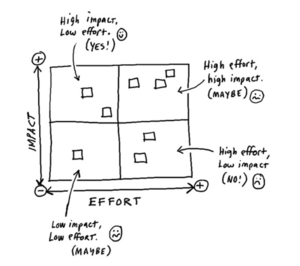
In this decision-making exercise, possible actions are mapped based on two factors: effort required to implement and potential impact. Categorizing ideas along these lines is a useful technique in decision making, as it obliges contributors to balance and evaluate suggested actions before committing to them.

Duration: 30m - 60m
Participants: 3 - 15
Difficulty:  Low

Goal

To generate ideas and examine them by two factors: Impact and Effort

Materials

    Instructions

    Flow

    Given a goal, a group may have a number of ideas for how to achieve it. To open the exercise, frame the goal in terms of a “What to do” or “What we need” question. This may sound as simple as “What do we need to reach our goal?”

    Ask the group to generate ideas individually on sticky notes.

    Then, using Post-Up, ask them to present their ideas back to the group by placing them within a 2×2 matrix that is organized by impact and effort:

    • Impact: The potential payoff of the action
    • Effort: The cost of taking the action

    Attachments

    • Imapct and effort matrix cover.PNG

    Background

    The source of the Impact & Effort Matrix game is unknown

    Source: Gamestorming

    Author

    Gamestorming is a set of co-creation tools used by innovators around the world. Think back to the last time you played a game. What was the game? Why did you choose to play? Was it a simple game like tic-tac-toe, or something more complex, like Monopoly, Scrabble or Chess? Or maybe it was a game of basketball? Did you play with friends? With family? Try to recapture the feeling you had as you played the game. How did it feel? Would you like to have more of that feeling at work? Games come naturally to human beings. Playing a game is a way of exploring the world, a form of structured play, a natural learning activity that’s deeply tied to growth. Games can be fun and entertaining, but games can have practical benefits too. These games are designed to help you get more innovative, creative results in your work. We’ll show you not only how to play them but how to design them so they fit your own specific work goals.

    More about author

    1 Ratings 

    This method has been rated 1 time(s), with an average rating of 5.0.

    1 Comments

  • Interesting approach
    over 4 years ago
  • Please Log in or Sign up for a FREE SessionLab account to continue.