Give and Take Matrix
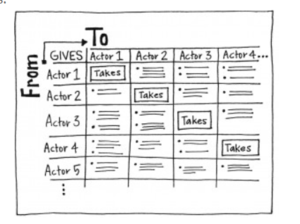
The goal of this game is to map out the motivations and interactions among actors in a system. The actors, in this case, may be as small-scale as individuals who need to work together to accomplish a task, or as large-scale as organizations brought together for a long-term purpose. A give-and-take matrix is a useful diagnostic tool, and helps players explore how value flows through the group.

Goal
The goal of this game is to map out the motivations and interactions among actors in a system.
Materials
Instructions
Preparation
To begin, you will need a list of all the actors in the system. This may be prepared in advance or generated at the start of the exercise.
Using the list, create a matrix with the list of actors along both the horizontal and vertical axes.
Each cell in the matrix captures only one direction of the flow. For example, a supplier may give a certain value to a manufacturer, but a manufacturer will give a different value to the supplier. For consistency, the vertical axis can be considered the “from” and the horizontal axis the “to.”
Flow
- Primary motivations: For each actor in the matrix, fill in “what they want” out of the system. This information goes along the diagonal, where the individual actors intersect with themselves. These should be brief phrases that describe a goal or reason the actor participates in the system.
- Intersecting interests: The next step is to look at the intersections, and capture what value flows between the actors. Start with a single actor and work through each cell, asking “What can I offer you?”
- For some intersection points, this will be easier to describe. In other cases, the matrix will expose previously unconnected actors and possibly those at odds with each other. The goal in completing the matrix is to find the most complete picture of how each actor can benefit all the others.
Note: Completing this matrix may involve research both before and after the initial mapping process. By using surveys or interviews, players may be able to explore and validate both the initial inputs and the intersecting interests.
Attachments
- Give and Take Matrix.PNG
Background
The Give-and-Take Matrix is inspired by a number of techniques used in engineering, chemistry,and design.
Souce: Gamestorming