“We could hand that SessionLab agenda to any one of our Guides”: how xchange scales transformative facilitation

At xchange, the future of facilitation is about unlocking collective intelligence at speed and scale. Founded by Jon Berghoff, xchange has developed a pioneering facilitation approach focused on care and transformation. More than 15,000 coaches, consultants and change agents now use it, and xchange has certified over 400 Guides through its academy.
Alongside training, xchange designs and facilitates high-stakes gatherings for organizations such as Google, Facebook, BMW, Stanford Medical, Conscious Capitalism, and others. Behind the scenes is a distributed team of ten people, split roughly evenly between design & facilitation and operations. And they are growing: their current focus is on enabling more of their certified guides to take on larger projects.
We spoke with Steve Bouchard, Head of Training and Client Relations, and Jana Smith, from xchange’s Member Experience and Operations team. They told us how SessionLab helps them run complex events, including integrated hybrid experiences with both online and in-person participants, keep facilitation quality high across a growing team, and equip an entire network of trainees and Guides.

Alignment, human connection and transformation
When xchange partners with a client, it’s usually with the leadership team: this could be a small executive team on an offsite, or 200 mid-level leaders shaping a strategy or envisioning the future. Sessions typically run from half-day to several days, often with xchange designed interactions woven into a broader event agenda.
Whatever the format, the goal is the same: to create the alignment and buy-in organizations need to adapt in a complex, fast-changing world.
Our process creates human connection, which we think is a necessary ingredient for organizations to continuously adapt and thrive in this highly complex and rapidly changing environment. – Steve
For Steve, a great client experience comes down to two things: impact and transformation. Impact is measured through pre- and post-event surveys and participant feedback. Transformation is often what people didn’t know they were hiring xchange for.
People come to us to get trained in a methodology, or clients hire us to deliver an outcome. What often ends up happening, that people don’t initially hire us for, is personal and organizational transformation. – Steve
As an example of transformation, Steve and Jana point to a member who joined the xchange community three years ago as a quiet participant. She started by facilitating a short session at a conference. She was invited back for bigger roles, and today she designs and leads that same conference, and many more in addition.
She told me that, through xchange, she has found her voice. – Jana
For xchange, stories like this one show the multiplier effect of its work. Someone transforms through the training, then goes on to lead transformational experiences for others. Connecting that growing network of Guides with clients who need this transformation is now the team’s focus.

One run of show for truly integrated hybrid events
Many facilitators avoid hybrid. xchange has made it a strength. In what Steve calls a “truly integrated” hybrid event, nothing is simply live-streamed from the stage. A full facilitation team works on site while a second team facilitates a parallel online audience, and voices move between the room and the online space as one community.
That takes serious coordination, and SessionLab is at the center of it.
Everyone’s looking at SessionLab, because that’s our run of show. There’s all kinds of information in there, not only from a facilitation standpoint, but also from a technical and operational standpoint. It keeps us all on the same page throughout an event. – Steve
Breakout rooms, chat messages and tech cues are all prepped and clearly set out in the agenda before the team goes live. xchange also shares its SessionLab agendas with AV teams, clients and other partners, who use them as their own show run sheet.
The results show up in participant feedback. After a recent large hybrid event, one online participant wrote in the survey that they felt like they were actually in the room.
That’s our goal. We want them to feel like they are right there experiencing everything. And without SessionLab, I don’t know if we could make that happen, because it’s so clear what’s happening in the room and online. – Jana

Consistent quality, whoever is in the room
With hundreds of Guides and a distributed team, consistency starts with the methodology. Facilitators who have been through the same training speak the same language and can work with each other naturally. xchange encourages each facilitator to bring their own style, but some parts of the process are carefully structured.
SessionLab is where that structure lives. Every xchange agenda follows the same layout:
- Design and facilitation (left side): notes, talking points and questions the facilitator uses to lead each activity.
- Operational support (right side): breakout cues, group sizes, whether groups are random or curated, and chat messages ready to copy and paste.
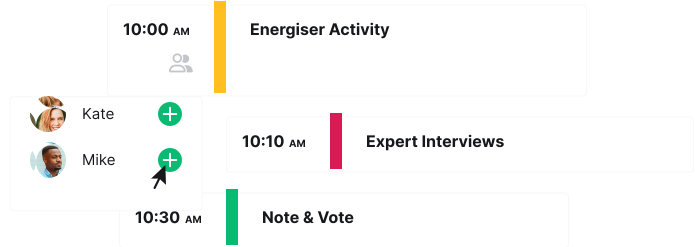
Assigning a team member to each block is a favorite feature, as it makes preparation fast. Steve recently reviewed a two-hour session with five team members in about ten minutes.
We put our names on each block and went through it, and we were synced up. Because everything is there, we can all follow along and we know what’s happening. It’s a great alignment tool for our team. — Steve
On event day, the team keeps the agenda open and updates timings as they go. If a block planned for ten minutes takes five or fifteen, their team makes a note of it. Survey links, workbooks and screenshots are linked in the agenda too, so the next run of a program starts from a full history rather than a blank page.
What it’s really doing is allowing us to build an organizational memory of how we design and deliver experiences. — Jana
That memory also makes the team resilient. If someone falls ill or a flight is canceled, a teammate who has shadowed the client meetings can step in with the SessionLab agenda and run the session.
We could literally hand that SessionLab to anyone on our team, and they can run it. It’s creating confidence and freedom within our team. — Jana
For operations, the clarity removes a lot of stress. Jana no longer has to ping facilitators to check what’s next: the flow, breakouts and handoffs are all there. Facilitators, in turn, can stop worrying about structure and focus on being present in the room.

Equipping a growing network of Guides
With its academy well established and a growing community of certified Guides, xchange is increasingly focused on client delivery. The goal is to build opportunities that connect Guides with meaningful client work, including larger projects over time. Tools like SessionLab already help prepare Guides for that work.
When students enroll, they get access to live training and digital course materials. They also receive a set of done-for-you resources to get started: slide decks, worksheets, agenda templates and proposal examples. According to Steve, the SessionLab templates are among the most valuable parts of the package.
Every student receives a collection of SessionLab content blocks for each of xchange’s signature choreographies, so they can build sessions from tested building blocks. In more advanced trainings, they receive complete single-day and multi-day agendas for running a strategic planning summit: the kind of high-impact engagement organizations really invest in.
We give them very detailed SessionLab templates to run, start to finish. That’s a really valuable piece of our package when a student enrolls. — Steve
Agendas like these take a long time to design, refine and write out. A newly certified Guide doesn’t start from a blank page; they start from the same design xchange’s own team would run. xchange built the library with help from SessionLab’s customer success team, and Jana sees the support running in both directions:
Using SessionLab is allowing us to support our members and our students at a very high level. But it’s also like you are supporting us. — Jana
As xchange continues to focus on client delivery, Steve is also exploring SessionLab’s new Session Request add-on, which allows users to manage how to assign facilitators to different sessions. “That’s the direction we’re going,” he says, “so it’s good timing.”

A hub for every client event
Every client event at xchange starts from a template. Steve has been experimenting with SessionLab Pages to turn it into an event dashboard: one place to go for everything about an event. It holds the basic event information, links to key materials, travel details and a set structure for the planning calls with the client.
Until now, that information was scattered across a note at the top of the agenda, a separate document, or the team’s project management tool. Bringing it into one hub means everyone starts from the same picture, and the team can choose to share it with the client too.
Not every project is the same, but most follow a similar path, and the dashboard gives the team clear guidelines to follow.
It’s 80% of projects that will flow through this process. Things like that help maintain quality. — Steve
The right level of detail for every audience
Jana and Steve are fans of SessionLab’s options for sharing views. The web view and overview options let them tailor how much detail people see: a full picture for the team, and a simpler one for clients and participants.
There are certain levels of detail that we want to see as a team, and certain levels of detail that we want a client to see. That all works out well. — Steve

Plan tight, hang loose
For xchange, SessionLab has become the backbone of how a small, distributed team delivers complex experiences, and how a growing network of Guides can deliver them too. Clear structure lets the team take on more complexity: bigger groups, more facilitators, more technology and integrated hybrid formats. Perhaps most importantly, it frees facilitators to focus on the people in the room.
Jana is so convinced that she has a rule of her own:
I’ve often said I won’t do an event unless there’s a SessionLab agenda, and I’m not kidding.
Their advice for other agencies? Get out of documents and spreadsheets, and borrow a saying xchange learned from one of its mentors:
We often say: plan tight, hang loose. SessionLab is what allows us to plan tight. — Steve


Leave a Comment